And here is a hint: it’s not immigration.
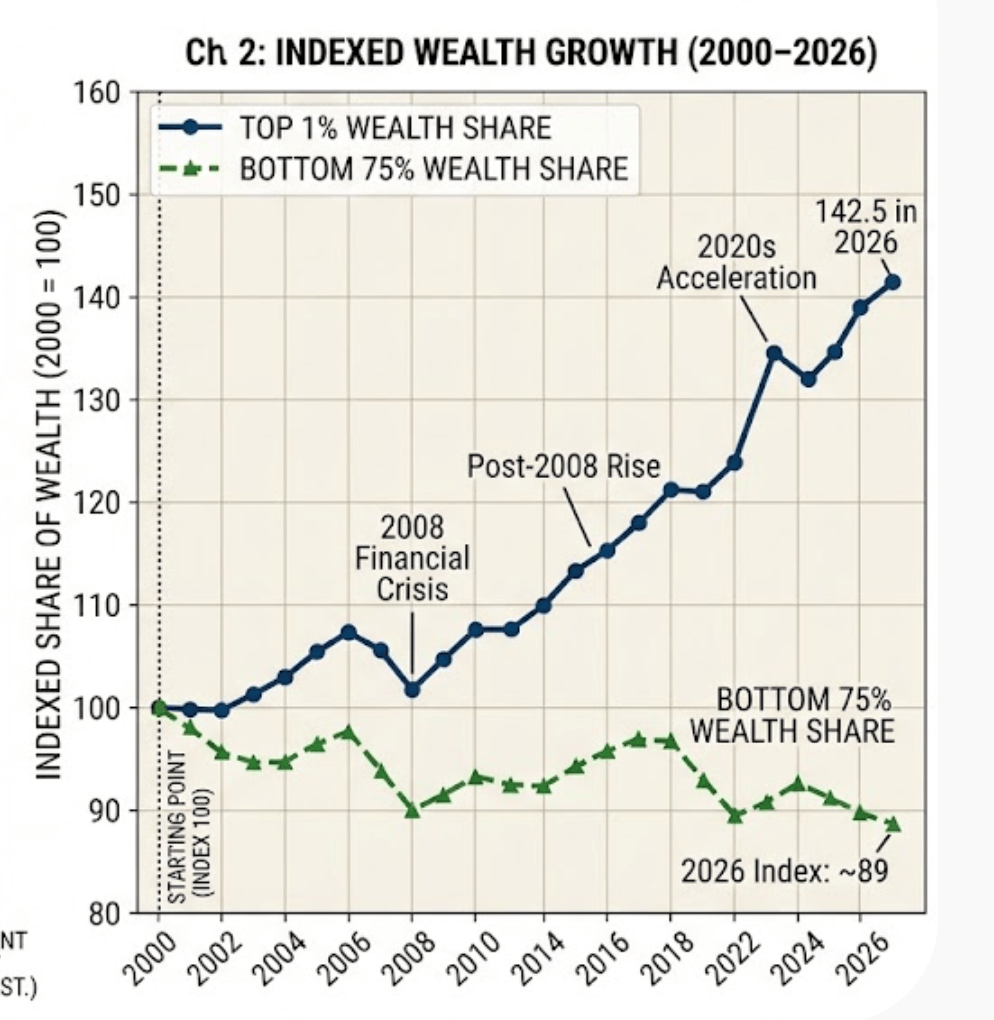
This chart should scare the pants off of you:
Are you still wearing your pants?
The data source for those charts is the Government’s Federal Reserve’s Distributional Financial Accounts (DFA). This chart is “indexed” to the year 2000, meaning that it shows how both populations have changed since then as a percentage, but does not show the absolute numbers.
You can go to this web site yourself and see a variety of analysis products. The very wealthy are different from the rest of us; they have more money. And their wealth tends to be in owned businesses, stock/bond market assets, and other investments, while the single biggest source of wealth of the bottom 50% tends to be their homes, which are not liquid and which are often heavily mortgaged.
The take-away from my opening chart is that the most wealthy 1% (approximately $12 million or more in personal net worth) in the US have seen their bank accounts, as a share of total individual wealth, steadily grow by leaps and bounds in the last 25 years, while nearly everyone else has had their wealth remain stagnant. Or drop. So, all the economic gains that you hear about on the TV (“our economy is booming!”) have gone to the wealthiest 1%. And the effect on the wealthiest of the 1% is even more stark.
The chart illustrates that, in my opinion, the most pressing problem we face here in America is not red v blue, but rather the uber-wealthy vs everyone else. You can see that the slope of the curve for the 1% does not change when the Presidents do; rather, it dipped for the 2008 recession, actually went up after the pandemic, but otherwise kept on the same trajectory as before regardless of which party was in office.
When wealth accumulates at this level, the 1% will capture the government and change the laws and policies to the benefit of themselves at the expense of the average person. The very rich want to protect their way of life – just like we all want to protect our way of life. However, when the very wealthy do this, everyone else gets hurt, because they have influence over the legislators and the executive. We are living the result.
I personally think that this started with the economics of Milton Friedman in the 1970s, by preaching the gospel of “shareholder value.” [See my earlier post on this topic at https://grandpadave.blog/lets-talk-about-share-buybacks/] In short, the idea of shareholder value is that the only goal of a corporation should be to return as much money as possible to the owners – that is, the shareholders. They will then, in theory, give back an appropriate amount of this to the employees, the business, and the customers. Any attempt to hold corporations accountable to arbitrary standards other than “maximizing shareholder returns” will lead to socialism, harmful regulations, and bankruptcy. This concept was quickly endorsed by business and government leaders because it made them personally wealthier – prominently including Ronald Reagan.
Many of us seem to think that the 1950s and 1960s were the ‘golden years’ of American economics, with most Americans perceiving prosperous presents and hopeful futures. Which was true! This was due to the government’s intentional policies to level the playing field for all economic brackets during and after WWII. It also led to a revolt by the rich. (For example, my Dad hated FDR.)
I am reminded of FDR’s New York City campaign speech in 1936 where he refers to the fact that the very wealthy will hate him for leveling out their money. He says: “I welcome their hatred!” You should read it; this is a link to a transcript. Please, you really should. You don’t hear our government officials saying this today, in either party.
I just went on a side trip in order to compare Trump’s speeches this year, like the one referrenced above in Iowa, with FDR’s speech at Madison Square Garden in 1936. I discovered something I did not expect. The video of his speech as presented by National News Desk was misrepresented as taking place recently, in October of this year at the Horizon Center in Clive, Iowa. Clive is a small suburb that is basically part of greater Des Moines. The speech actually took place in January of this year, but was shown to conservative viewers to support Trump’s pre-midterm campaigning by The National News Desk. They were intending to pump up support for Republican candidates by Trump voters. The National News Desk is lying about it.
National News Desk is a morning news program that is provided to Sinclair owned TV stations. Sinclair owns 295 local TV stations in 89 markets, so they blanket the country with their programming. This means that significant numbers of Americans are presented with this morning news program as their daily diet of what is happening, presented as the objective truth. It turns out that the Sinclair Broadcast Group is strongly conservative and puts Republican supportive “news” clips on their franchisees on a regular basis. Like this one.
OK, back to comparing the speeches. I ran them both through a linguistic analysis, and the results are: Trump speech, 6th to 8th grade, or casual spoken speech. FDR: 11th to 12 grade, or text that requires some thought and education to understand. This might not be a bad thing for President Trump, as he wants to appeal to the “average” American, using simpler words, no references that a 6th grader would miss, and sentence construction might make him more relatable. So I am not sure if this is a reflection on the candidates or a reflection on the voters. I will let you pick. For me, the main take-away is that the conservative media that presented Trump’s words was untruthful about them.
Back to the theme of this blog post!
Let’s be clear with our elected officials. There needs to be a more equal distribution of wealth.
To the average American, this would look like being able to hold a job that pays a living wage for their family, being able to buy food, housing, and recreation, and to be able to get health care when their family members are sick, ensuring that a single illness will not bankrupt the family.
To the the 1%, it will look like we are trying to steal their money, so be prepared. They will hate it.

