I am presenting this one as a series of segments based on information as it unfolded. Presenting it this way, I hope, is going to amp up the dramatic tension and make the whole thing more exciting! Please treat everything in this post as my own opinion, not that of any US air authority. I have done a bit of research, but still.
Friday Night November 13, 2026:
Friday, at around 4:30 EST, something happened to the FAA’s Air Traffic Control System supporting the 22 high altitude ‘Air Route Traffic Control Centers” or ARTCCs known as en-route centers, and the FAA ordered a ground stop on all air travel nationwide. No planes could take off.
Yikes!!!
It lasted for about 4 hours. This has only happened twice in the era of modern air traffic control; on 9/11 (when it grounded all aircraft, which was worse) and in 2023 when some equipment failed during a system upgrade in Dallas. Many of the headlines, including ABC News, said essentially: “Trump administration blames aging equipment.” There is such a high level of distrust by the public of any and all of those in authority today, that it is going to take some time to understand what really went wrong. Our first instinct as humans is to blame someone or something.
A good friend of mine immediately blamed the Iranians. I think a lot of people are in his camp on this, without any relevant information. It is possible, certainly, that the event was triggered by a cyberattack, but I don’t think it to be the most probable scenario.
Congress is blaming the FAA, while the FAA is blaming Congress. I think it most likely that an equipment issue triggered the problem, with the FAA acting conservatively to restrict the amount of air traffic they can handle given reduced communication ability at the ARTCCs. It is unclear at this early moment just why the equipment failed. But good for the FAA for making sure that no one was hurt.
Surprisingly, our President Donald Trump immediately blamed his predecessor, Joe Biden, for letting the air traffic system fall into such disrepair. Then he turned to brag about the construction in the new and giant White House ballroom…. (I wish I was making this part up, but no, I saw him do it on TV.)
The local airport-based Air Traffic Control (ATC) towers were apparently not impacted, just the controllers that help keep track of, plan, and communicate with the planes en route at altitude between cities. They have backups for that, but the backups can’t handle as much volume of air traffic.
Secretary of Transportation Sean Duffy stated publicly that network routing equipment became saturated with too much data traffic, resulting in the data needed by the ARTCCs not getting through. A data overload is certainly possible, but it does not explain why there was a single point of failure in this system so critical to safety.
And we are still clearing the planes from their parking spaces on the tarmac. The parking lot of lost airplanes has been busy. You can see this parking lot as the white area in the upper right hand corner of the Google Maps image of the airport below. There is not enough space to buffer all the rush hour flights arriving for 3 or 4 hours without freeing up the space from departing planes. At Newark, planes land at a max of about one every two minutes, so they pile up pretty quickly if the outbound ones can’t get out of the way at the gates and ramps.
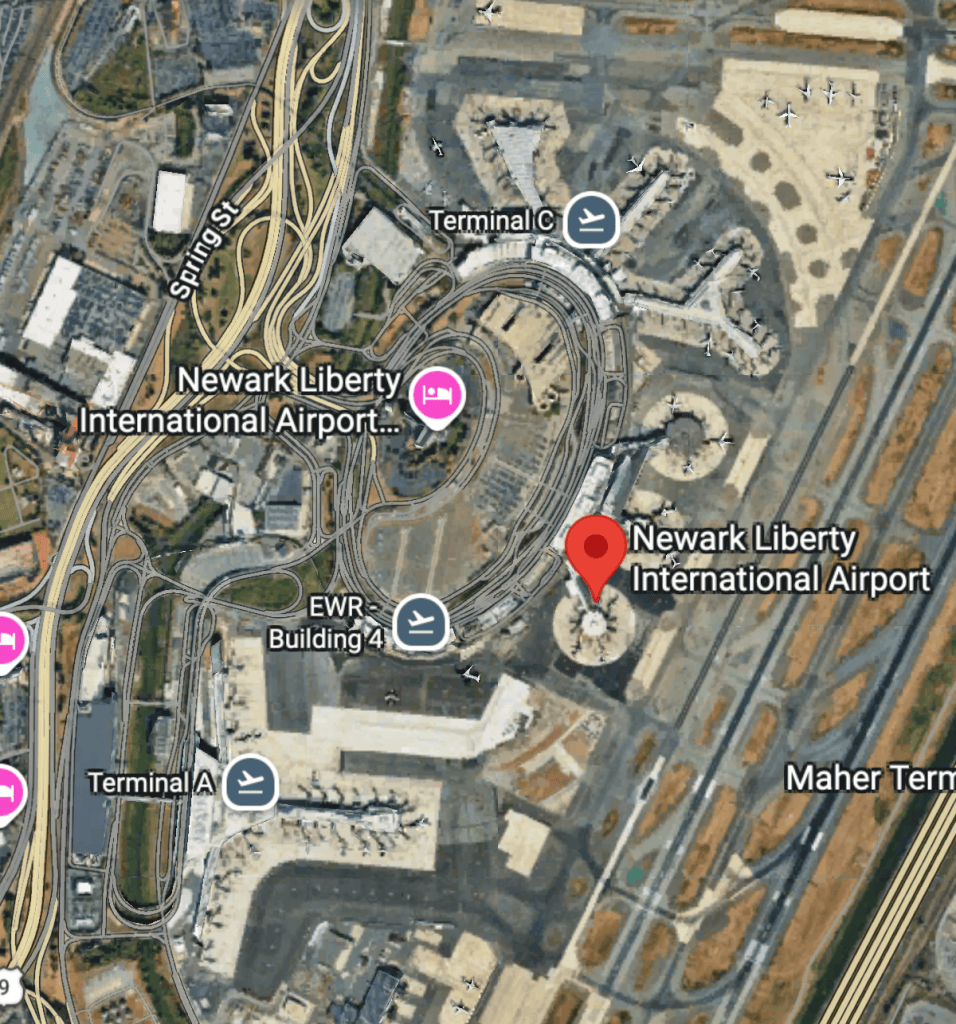
I got into this right after it started because a friend was on a flight from Tampa to Newark when the ground stop was called. I was looped in by a family member as an informed voice regarding what is going on when stuff happens in our commercial air system. I gave my best advice, which was reassuring I hope. The key in my mind was observing EWR (Newark Airport) activity on FlightRadar24, where I could see that planes were landing routinely but just not taking off, and then tracking the flight, which was on time in the air and going the right way. The plane actually landed on time, around 6pm, but was not able to let passengers off for another 3 or 4 hours due to the above-mentioned traffic jam in the Newark airport airplane parking lot of lost airplanes.
Saturday Morning, November 14, 2026:
A Department of Transportation official noted that the FAA started the rollout of a new and modernized system for managing air route traffic in the last few days. The system is called SMART. It is a AI-based predictive planning system that sucks information in from hundreds of existing FAA and weather data sources, and then uses AI to integrate them with flight path simulations so that en route controllers can see where potential air route conflicts might be before they occur. It does not directly control air traffic flow, but makes recommendations to the controllers as they continue to do their jobs. The rollout was initially to take a year or so, but selection of the vendor and system rollout was accelerated this year.
[My editorial comment: President Trump always wants everything done immediately, and consequently the quality is often poor. Some things take time to be done right. Did this happen here? I don’t know.]
November 10, this past Monday, was the scheduled date for starting national rollout of SMART to all ARTCC air route centers after a contained and successful experience with the D.C. center. I could not tell what additional loads it might be placing on the existing network systems that are in use for air route data. Coincidence? Perhaps.
The SMART system is the product of ASI, formerly Air Space Intelligence. It is owned by three tech-guy founders and funded by several venture capital firms. One of these is 1789 Capital, which has Donald Trump Jr on its Board of Directors. I did not see any evidence that ASI got the contract because of this, but the appearance of a conflict of interest raises my eyebrows. ASI and their products seem to be on the up and up, solid technology that should help with air route management.
Sunday Morning, November 15, 2026:
Sean Duffy, the Trump-appointed Secretary of Transportation, is now blaming L3Harris, a contractor whose employees were upgrading some telecommunications equipment in a remote Arkansas location and also replacing older wiring there with fiber. The Washington Post report said that the new router “made 1,000 data requests every 3 to 5 seconds” which is, like, hardly any. So, their version might be true. Or not.
The larger context in my mind is still that the Trump administration got rid of many experienced FAA people whose job it was to do the upgrade carefully but more slowly. For example, one of DOGE’s initial actions was to fire about 400 FAA technical experts who were responsible for the safety and effectiveness of maintenance upgrade rollouts. Is Elon Musk in jail over this? Apparently not.
Secretary of Transportation Duffy was, among things prior to his current job working for Trump, a prize winning lumberjack (winning multiple speed-climbing titles!), a reality show contestant on The Real World – Boston, and a Fox News on-air personality. In his defense, he also served as a member of Congress representing Wisconsin’s 7th district, and served a term as a Wisconsin County District Attorney.
Here is Sean Duffy’s explanation in today’s news as reported by Reuters: “We’re working to determine whether we had incompetence, meaning was it user error or installer error from L3Harris, or did they install a faulty router? We haven’t determined what the fault was,” Duffy said.
Notice that all of these explanations are attributed to a random, isolated, single mistake made by an anonymous contract employee. This could have happened to anyone! The Government had nothing to do with it! The important point is that we are moving ever closer to pinning this whole thing on a single incompetent individual who doesn’t even work for us! Maybe he was in intern! As soon as we fire that guy, or replace the one bad Arkansas router, air travel will be safe again!
Monday Morning, November 16, 2026:
Captain Steve, a commercial pilot, does an video podcast on events in commercial air space. He says that the ERAM, which is the air traffic control system that manages flight plans, communications, and traffic handoffs above 23,000 feet altitude on behalf of the ARTCCs, became unavailable on Friday at around 3:30 EST. So just this specific FAA application, not the whole network or service. This happened because L3Harris, who manages and operates the private FAA internal network (i.e., not connected to the public internet) linking the 22 air route ARTCCs, was doing an update to a piece of network equipment as part of the ongoing project to replace old tech with new fiber-based tech. This update was problematic and caused a modem connecting the center to the rest of the network to overload and crash. The traffic bottleneck then rippled to the Chicago ARTCC, where it was first detected, then tripped over to the Boston IT network equipment, causing ERAM there to overload. This cascaded to the other ARTCC air route centers, and thus stopped ERAM from being connected to the controllers (or to its own sources of data). At that point, there were backup systems but the controllers had lost access to the detailed flight plans – as well as communication with pilots – and thus could not handle the high volume of traffic on a Friday evening rush hour, so the FAA wisely declared a national ground stop in order to quickly reduce the controller’s air traffic load while they got the system back up. No planes could take off, and ones in the air already could finish their filed flight plans and land safely.
I discovered that when ERAM is working, pilots can change their filed flight routing as they go, in order to adjust to changing conditions. Because they lost radio contact with the ARTCC controllers who managed the flight plans for everyone, the safest thing for all the plans was to fly as originally planned, therefore not surprising each other.
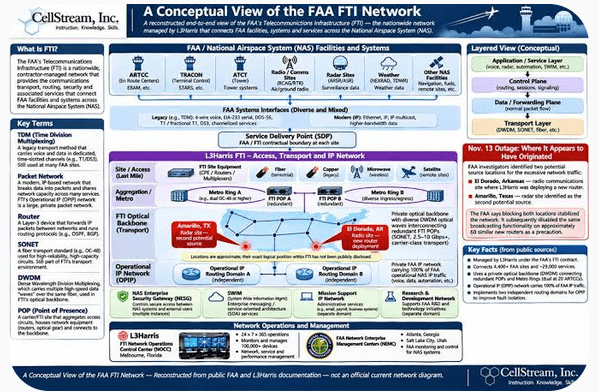
One potential complication was that L3Harris, who is currently running the FAA network, is in the process of being replaced by AT&T who was awarded the multi-year fiber upgrade contract. However, the contract had been awarded to Verizon and recently that arrangement was cancelled by the Government in order to award it to AT&T after Verizon had already started work.
Let’s back up a bit to look at the Verizon/AT&T transition. The overall modernization project is called FENS, the FAA Enterprise Network Services contract worth $2.4 billion over 15 years. $2.4 billion is a lot of money. The FAA continues to oversee everything about this work, with ultimate responsibility for deployment. (So please cover your ears when Secretary Duffy says a contractor had total responsibility.) Verizon was awarded the contract in 2023 and was working towards the contract goals when in 2025, a network outage occurred in Dallas. This caused the FAA senior people to decide that the FENS modernization work was not going fast enough. For reference, Congress passed legislation requiring the upgrade in 2003, so they may have had a valid point.
As a result, the government arbitrarily set a hard deadline of December 2028 for the part of it to be completed that pertains to Friday’s outage. This pulled up many of the deadlines by 9 years. Nine years! Verizon apparently said that this deadline could not be achieved while still maintaining safety and integrity margins as contracted, so the Government yanked most of it from them after AT&T promised that they would meet the deadline and everything would work perfectly as long as it was awarded to them as non-competitive bid.
My former defense contracting experience tells me that this was no-bid award was a recipe for failure. Of course AT&T promised to finish on time… just give us the $2.4 billion, and we will take it from here. Why would we exaggerate the likelihood of on-time completion? And what could possibly go wrong?
Was there undue influence in awarding the FENS contract as a no-bid sole-source to AT&T? I don’t have any information one way or the other, but this Administration has a history of awarding Federal contracts to campaign donors and others who get selected for reasons other than their ability to complete the work on time, with quality, and under budget. AT&T was a big-time contributor to Trump’s last campaign fund and to many other Republicans. I have no specific information that there was any sort of quid pro quo on this particular thing, though.
Was the FENS project going too slowly? Apparently, yes. You can have a long discussion about whether this was Verizon’s problem or the Government’s. Or L3Harris’, who had it prior to Verizon. My opinion, again based on very little hard facts, is that Verizon was working within the terms of their contract, which prevented them from going any faster. I don’t have any inside information. In any event, the result (in my opinion and guesswork) was to rewrite the FENS contract without the checks and balances and legal obligations that were slowing Verizon down. It’s possible that this will ultimately benefit our air traffic system, as things will get done now that were not getting done before. I think that some of these things are going to break more stuff along the way. Just my opinion.
Note that the ERAM system is separate from the FENS contract; FENS provides the networking “pipes” connecting the various computers and ATC centers, while the ERAM capability continues to be managed by a company called Leidos. The existing pipes (“plumbing” in the vocabulary of Al Gore) that are being replaced, and that were involved in the crash, are evidently data modems transmitting at relatively low speeds over copper wires. Quite reliable, but just a lot less bandwidth that fiber.
In the news reports, various Government officials have been saying that the problem was with a “router,” then they would say it was a “switch”, and I heard from a former controller that it was a “modem.” These are different! The ATC centers are connected by a private IP network, meaning that it is like the Internet that we all use, but completely disconnected from the things that we search for. Like this blog. Or Instagram. So what are these network gizmos? Allow me to DaveSplain.
In the network of networks (“the Internet“), devices that are in the same room or physical area are connected with a switch. A switch allows devices, like your laptop and the printer in the same room, to talk to each other. In order to talk to something not in the same room, there needs to be something to bridge you over to another network.
That thing is a router. It “routes” data between the network that you are on and some other one, potentially somewhere else in the world. Your laptop connects to the Wifi device in your home, which then “routes” your request to another network that it knows about because it is connected to both the one inside your home and the one that your wifi router links to, say Verizon.
On the other hand, “modems” are electronics that take computer-generated ones and zeros, and encode them into tones that can be transmitted as if they were voices talking on the lines. At one end, data goes in as ones and zeroes, gets sent over wires as tones, then comes out again as the reconstructed ones and zeroes. This is a well-known and stable technology, but compared to fiber connections, it’s a zillion times slower. Apparently these formed the original network backbone of the FAA system.
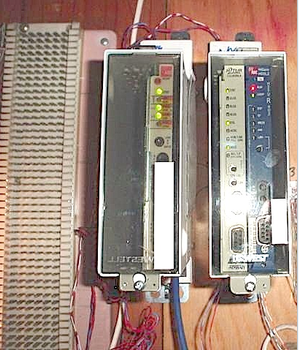
Many of these links are synchronous and not packet switched, like the formerly ubiquitous T1s and DS3s. Remember T1s? DS3s? I do. At 1.54Mbps, a T1 was the super-duper height of technology in the 1970s. The clocks had to be exactly synchronized at each end, with the process repeated whenever you went to the next one. It was inherently cumbersome. And expensive.
No one is arguing against ATC tech upgrades, but it needs to be done carefully given the safety aspect of air traffic.
Speaking of which, this past September the GAO issued a report based on their evaluation of the overall FAA modernization project. They concluded that FAA’s management of the work was a key deficiency in air traffic safety because there are thousands of individual upgrade projects and no overall plan to coordinate their implementation. This overall planning has to be the responsibility of the FAA, not a contractor. A babysitter does not become the mom just because you hire them and blame them when the baby cries.
Tuesday Morning, November 17, 2026:
But wait! There’s more! On Tuesday CNN reported that the FBI has arrested the accused criminal router and taken it from the rural Arkansas airport to their interrogation lab in Washington to see if they can get it to confess that it did the crime. You can’t make this up. I am slightly altering the wording, but yes, the FBI has taken the accused Mr. Router from the scene of the crime at the South Arkansas Regional Airport just west of El Dorado (city name rhymes with “potato”) to its lab.
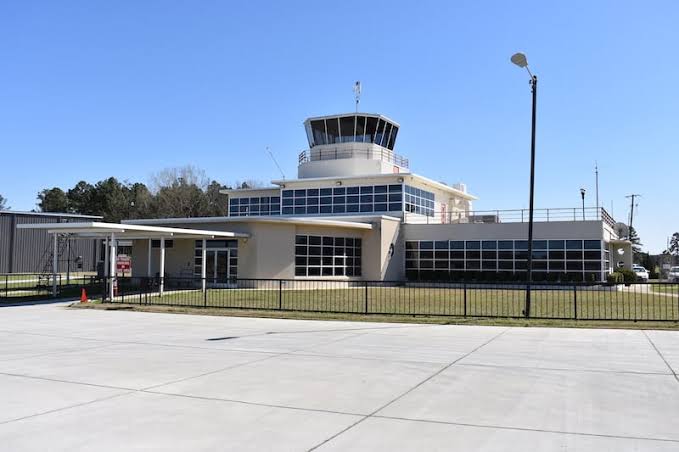
We are all waiting to see if FBI agents, our best Federal police, can get it to squeal.
So where are we on this? Here are my take-aways so far:
- All the planes in the air at the time of the ground stop landed safely, and no one was injured as a result of an airplane, and all the backup systems worked as designed;
- Please re-read the first bullet point. It is the most important one.
- The FAA and Congress are working hard to blame each other and not themselves;
- Public statements by the Secretary of Transportation often don’t seem to be making all that much sense yet technically;
- The media is focused on inter-personal conflict, blame, and anger by those who were inconvenienced, and they continue to interview people who have no idea what happened or what they themselves are talking about, so don’t get too carried away by the news;
- Something went wrong technically in a tiny municipal airport in rural Arkansas, triggering a national shutdown, where the system clearly should have had adequate resilience to shrug off anything that happens at the South Arkansas Regional Airport. None of the press reporting or Government statements so far has seriously addressed this obvious part of the problem. My analogy to this is when a guy with a water pistol shoots a police officer wearing a bullet-proof vest, putting a hole in the vest. The problem is not the water pistol;
- Significant work has been underway for years to upgrade the technology of our air traffic system, and a variety of technical, managerial, competence, and political hurdles have gotten in the way of completion. Most of these hurdles still remain, but work really is underway to modernize the FAAs computers.
Stay tuned, I’m sure there will be more.

