OK, this is a little off the beaten track, but I was just thinking about something I read the other day where the author said that recent songs are mostly in a minor key, and that this was rare in the 1950s and 1960s when popular music was mostly written in a major key. Why did this change?
The author claims it is because older songs were written by a single individual who was telling a story, and it had an arc from beginning to end; the minor key was only used for songs that told a sad story. In the 1950s and 1960s there were not many of these given that we are talking about popular music which is generally happy. Here is one of the charts that back up the assertion:
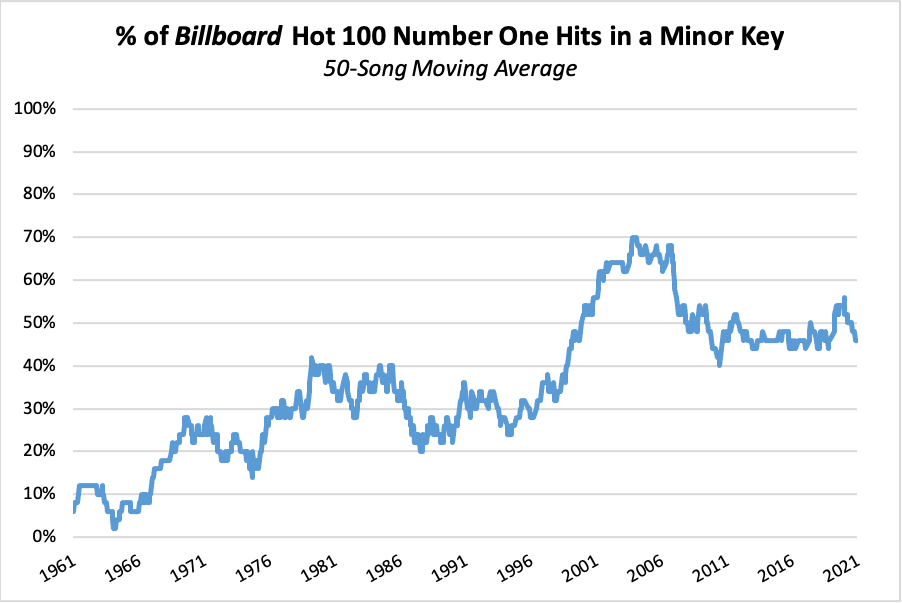
This says that about 5% of songs in 1961 were in a minor key, while upwards of 50% are now. Why? The claim is that recent songs are written and recorded around a ‘hook’ that is ‘looped’ where a phrase or rhythm and short chord progression is repeated over and over again throughout the song without there being any musical sense of opening, exposition, and closure that is followed by the tone of the music. One musician brings the ‘hook’ into the studio, it gets recorded first, and then the producer brings everyone else in gradually to fill out the producer’s idea of what will sell the best. Not what emotional message the artist was attempting to convey. And there is no beginning or end; the song just plays over the loop. The loop tonality is often in a minor key, but the repetition and the shortness of the looped phrase result in listeners not noticing so much, and therefore not becoming so sad that they don’t pay for the music.
Can this be true?
I decided to explore the topic. I listened to a lot of pop songs along the way, so even if you don’t like this blog post, I still had fun. You’re welcome.
First, what are we talking about?
A hook is a general term for a memorable element of a song designed to stay in the listeners head. Another word for this might be ‘earworm’. This is definitely not a new idea! It can be a lyric, a short musical phrase, a rhythmic beat or phrase, or anything else included in the recording.
A loop, on the other hand, is a term used in the production part of a recording session that repeats an element of the song from a recorded fragment. Like a hook, anything captured (typically the hip word for this is “sampled”) by a recording device can be repeated this way, providing a foundation or structure for the song.
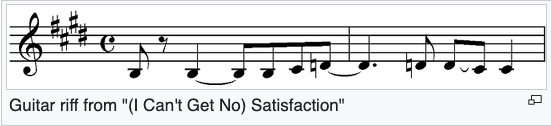
A good example of a hook from 1965 is the Rolling Stones hit (I Can’t Get No) Satisfaction. Here is it in case you are not familiar, or just want to hear is again, as I did:
Keith Richards, the guitarist for the band, famously heard the opening riff — which is the hook — in a dream, woke up, turned on a tape recorder (of course he had one on his bedside table), and played what he heard in the dream. Then he fell asleep again. The next day or so he brought this phrase to the other Stones and they helped him flesh it out into one of their biggest hits. The ‘hook’ phrase is definitely an earworm; they did not loop it in the modern production sense, but it repeats throughout the song, providing a foundation for everything else. The song is in E major.
Fun fact: as a result of this opening phrase, the Gibson fuzz box sold completely out of stock within a few months of the release. I bought one! Mick Jagger, the frontman, wrote the lyrics while at a pool at a hotel in Clearwater, FL sometime after Richard’s dream. The lyrics describe frustration with not being able to get what the singer wants, such as material goods or sex. The sex part was a big controversy in 1965, as you might imagine. I can remember when this happened.
Here is the hook written out:
To get some context for how repeating musical phrases or themes go back to ancient history, here is a song (work? piece?) by J.S. Bach, written during the first decade of the 1700s when Bach was living in Arnstadt, Germany. It illustrates the use of a ‘hook’ that repeats as the piece progresses with other notes added to fill out the harmonies and rhythms:
I love this version of it! You can see where the hook comes in and out, and it repeats in each manual of the organ as well as in the pedals, usually entering on a different key, and sometimes the notes of the theme are inverted. It is amazing. This video version was played on an organ, with the visualization added later. Here is the hook written as more traditional notes:

In classical music, this is called a “fugue” (fyoo’ g) which is a fancy word for a round, like row, row, row, your boat. Fugues are generally a lot more complicated than rounds, but the idea is the same. It is a phrase that is repeated throughout the piece in order to give it a foundation, and it typically comes in and out in different keys and from different instruments. In a round, the hook is the whole piece.
For a more representative example of a hook that was sampled and then played underneath someone else’s recording, here is the drum solo from a James Brown song titled “Funky Drummer”, released in 1970:
https://youtu.be/jOCNmimkFTs?list=RDjOCNmimkFTs.
Now listen for that drum phrase repeated underneath “Waiting for That Day” by George Michael, released by Michael in 1990:
Note that the drum riff is slowed electronically in the looped version. This is allowed! You can change stuff. The original drummer, Clyde Stubblefield, received nothing from this reuse; there were royalty payments from George Michael to James Brown, but they all went to Brown’s recording company, not to the musicians. Further, the Rolling Stones got in on the action because at the end of the song, Brown uses the chorus from the Stones’ song “You Can’t Always Get What You Want.”
The drum riff turned out to be one of the most “sampled” phrases or music elements in the past few decades.
A very extreme, and I think both simple and archetypal, example of a sampled loop is this one:
“B.Y.S.” (https://www.youtube.com/watch?v=DoX8MoQhARU)
by the duo group Gang Starr (note the phonetic homage to the word “gangster”). If you follow the link, you will observe that the entire song, from the first note to the last, is a repetition of just one 2-beat measure. That’s it. You can’t make this stuff up. The artist speaks rhythmically over the sound, otherwise known as rap style. “BYS” apparently stands for “Bust Your Shit” (as in “I’m gunna”) and the lyrics are an exposition of how the speaker is bigger, stronger, and more dominant than the listener. Along with a generous helping of four-letter words, just to reinforce that the speaker is the apex predator, and the listener is the food. At least, that is how it came across to me. Perhaps it was a rap metaphor, I don’t know.
For an example from the 1960s of a pop song with a repeated hook that was not engineered technically as a recorded loop, take a listen to this version of “Hey Jude” by the Beatles.
This video version was filmed in 1968 at the Beatles’ Abbey Road Studios, and they recruited about 300 random bystanders, mostly from out in the street, to chime in on the last part. The guy introducing them is David Frost. The “nah nah” part starts at around the 4 minute mark of an 8 minute film. I had not seen this one before — it is way fun!
The second half of the song, where the song repeats “Na, na, na, na, na-na-na-nah – na-na-na-na – hey Ju-ude,” just goes on and on repeating the hook, with what feels like a rising tone giving the feeling of a hawk circling forever higher on a thermal. OK, so I like the Beatles. Paul apparently wrote the lyrics to comfort John’s son Julian after John divorced Julian’s mom Cynthia in order to marry Yoko Ono. Honestly, we were all pretty sad when John dumped Cynthia and married Yoko. The original lyric was “Hey Julian” but they all thought it worked better with the mono-syllabic word Jude, which was just a name they substituted to make the meter cleaner.
A more recent and perhaps more representative example is
Say So (https://tinyurl.com/556dha3t) by Doja Cat.
This one is quite pleasant and repeats an 8-note rhythmic phrase over and over again, first on the tonic, then down two half steps, with an occasional change to the IV and V chord of the key. It’s not Bach. (It is hard not to count “1,2,3,4,5,6,7,8” out loud while the song is playing. Try this while listening and I’ll bet you can’t stop.) All the while the bass guitar and kick drum provide a repetitive walking beat that is very soothing and captivating, albeit over and over again. The lyrics are about a girl who is sad because her boyfriend is too hesitant or too shy to come right out and express his feelings. So I am calling it certainly repetitious and minor in tone, and while I can’t hear any sampling, the 8-note phrase totally loops. It seems a little auto-tuned, though. I don’t know anything about the artist Doja Cat, but in the story video she is shown in what I would call a cat suit, so there must be a “cat” connection somewhere.
I needed a more objective way to understand this, so I went to the Billboard Top 100 and pick off the top 10. We are going to listen to each one, and then come to any appropriate conclusions. Meanwhile, we get to listen to popular songs! Here they are, in the order as presented on the Billboard list, starting with #1 for this week, which I pulled on November 7, 2026. I discovered that artists typically release two versions of the video attached to their songs – one tells a visual story, which is sort of related to the lyrics of the song, and the other just plays the song under a presentation of the lyrics. Each description below has a link to the lyrics version, but I watched them both. Feel free to do that yourself; some of the story ones add to the artist’s vision. Here goes:
- Choosin’ Texas, Ella Langley (https://tinyurl.com/nse35mp8). The kick drum has a repetitive beat, and the song a simple chord structure, but otherwise I would say that this twangy country song tells the story of a girl who is from Tennessee but who is sadly observing that her boyfriend is still hot for his old flame when they take a trip back to Texas. It’s been on the charts for a long time. The lyrical arc is traditional country, but the repeated 1-2-3-4 step is danceable and Ella’s voice is warm and satisfying to listen to. I liked it. Conclusion: not loopy, but minor.
- Housewife, Linda McRae (https://tinyurl.com/yrebvwsu). The overall tone is three chords that repeat, and have a definite minor tonality. They are Cmaj7, Em, and D. So I would say that this one loops bigtime, just not as overtly as my archetype loop song B.Y.S. above. The lyrics seem to be about a famous singer (like McRae, perhaps?) who yearns to be able to make her own decisions and to be able to be independent, but has not achieved it. The story video is basically soft porn, highlighting a young “Hollywood body” woman who is cavorting in skimpy clothing with the accouterments of the wealthy. Even the lyric version is McRae in skimpy clothing. I cannot figure out what this has to do with being a housewife. Conclusion: very repetitive in tone and rhythm, overlayed by a breathy vocal tone designed to attract teenage boys. Minor key, but not loopy.
- Boston, Stella Lefty (https://tinyurl.com/2kc9vs5m). This is another country twangy love-related song; the premise is a girl who finds herself in love with a guy when she did not expect it, and the lyrics explore her feelings as she thinks about where the relationship might go. The hook is Ms. Lefty’s rendition of the last line of the chorus: “I like it when you’re nice, I like it when you’re nice to me” which has a satisfying IV-I resolution to it. This one is all country, including a pedal slide guitar and everything, although it is set on a train heading to Boston. Where did the train start from? Tennessee? Ms. Lefty’s voice is captivating, though, so points for that. It is very listenable. You could line dance to it. Conclusion: repetitive walking beat, but otherwise not based on a looping, and a major key.
- Been By Now, Morgan Wallen (https://tinyurl.com/2s6358fn). Yet one more country twang-style song about sad love. In this one, the guy is sad that their relationship has gone nowhere, and the singer is basically giving up. This is a lot of repetition – very short verses, pounding back after each one with the hook “If was meant to be, it’d be by now.” Harmonically, just 4 chords, with no variation, minor in tone, and the rhythm walks along like a sleepwalker pulling on you. This would work for a country bar with everyone either two-stepping or slow dancing, and there are probably many who can relate to the relationship that has gone on too long with neither partner having the energy to break off. Repetition? Yes indeedy! I could hear the autotune, but it is somewhat subtle. Conclusion: Feels like a loop, especially the repetitive drum beat and simple repeating minor tonality.
- Dracula, Tame Impala (https://tinyurl.com/bde7z4ch). The story is (apparently) about a reclusive boy who wants to have a girlfriend, but bemoans the fact that he does not want to be out in the open about it. Or something. Originally recorded by Australian techno-pop artist Kevin Parker who records under the name Tame Impala, the version that is number 5 on Billboard is a remix of the original with South Korean rapper ‘Jennie.’ It was a hit on TikTok first, then went big time streaming as a single. I listened to what I think was the TikTok version. OK. The 1,2,3,4 beat is relentless, and there is no harmony. The singing is more than rap, but it does have that feel, as the main part of it only has two chords and they just go back and forth between the root and a half step down, giving it a very minor feeling. Which you notice. Then it repeats the ‘hook’, “Daylight makes me feel like Dra-cu-la.” Conclusion: The bass and the singing definitely loops, and I would call the rest just extremely repetitive. Minor key.
- Nicole Kidman, Adela Jergova (https://tinyurl.com/55jsxc4f). (Adela is a Slovak singer and songwriter; the video for this is essentially soft porn. None of this song makes much sense to me; you can’t dance to it, there is no discernable story arc, and why? It opens with a sped-up version of a gospel song, which commenters characterized as “sampled”, then goes into toneless harmonic talking that is VERY heavily auto-tuned. The lyric meter is so repetitive (did I say toneless yet?) that I needed a visit with Dr. Tylenol after playing it all the way through. The story is about a singer (the artist herself?) who lacks self confidence and goes out night after night thinking about the inadequacy of her own female body. This apparently reminds her of Nicole Kidman, with whom she has no relationship. Overall score: repetitive, toneless, and pointless.
- Expectations, Olivia Rodriguez and Chappell Roan (https://tinyurl.com/366e6ups). This song is fun! I liked the Texas one, but this is clearly way more fun than that, as that one had a sad story line. Expectations is about Olivia’s realizing that she can control who she dates, and the independence is heady and joyful. Anyhoodle, the music is not complicated; the main part is just two chords, going from a tonic to a whole step below, and back, which Olivia kind of happily sings around with her friend Chappell Roan providing vocal reinforcement and a bit of happy girl harmony. It opens with an exposed synth bass line of fast eighth notes in a 2-chord improv that repeats under each verse and chorus. (Think of “I Wish” by Stevie Wonder.) Some of it is heavily auto-tuned, giving the whole thing a techo-pop feel. In the last verse, the boy’s voice is heard without the running bass; the joyful bass line returns with the girl’s voice and words, and represents Olivia’s newfound independence from boys and freedom of choice. The video is super creative, setting the song as a series of dating game shows with some added narration to make the added story work. Bravo! Conclusion: there is some looping, but it supports a clear story arc, and a happy major key.
- Patient Zero, Taylor Swift (https://tinyurl.com/dzxf8vj4). I would classify this one as a ballad that could have been at home in the olden days. The chord progression is C-G-Em-D, and while it just repeats over and over, the song has a narrative arc that tells a story. The lyrics have a slightly sad feel, consistent with story of a girl who recognizes the heartache of a friend from her own personal experience. The rhyming evokes a rap style, but not the violent subtext of BYS. Conclusion: Loop adjacent, and major key (mostly).
- BbY Wow, Karol G wit Judeline & rusowsky (https://tinyurl.com/bd52dnhw). This is a danceable Latin/Reggae rhythm recorded by a Colombian artist Carolina Geraldo Navarro, who goes professionally by Karol G. The repeating part is the catchy walking rhythm, which carries through the piece and has you tapping you feet. Wikipedia claims that the recording samples this rhythm, which could be true; in any event, it repeats continually throughout. The lyrics, which are in Spanish so I had to go to a translation, are about a person at a dance club who is sad because they are missing their lover. Conclusion: the rhythm loops, tone reflects a minor key.
- Hate That I Made You Love Me, Ariana Grande (https://tinyurl.com/tcpvpk3m). Here the drum track totally loops. It’s not subtle. And it is only 2 beats. The drums sound like they were generated by a synthesizer and then just replayed endlessly. On the Wikipedia page there are 9 credited names responsible for the recording, and they all include “engineer” in their role descriptions; for six of them, that is all they did. The rest of it seems to be in the key of A minor, and the lyrics are about a girl who now regrets enticing her boyfriend to fall for her but is feeling sadness over the reality of his being insecure and wrong for her. Conclusion: this song is based on a (probably sampled) loop. And it is in a minor key.
All right, after listening to every Billboard Top Ten song from this week, what do you think? Is popular music crappier now than it was back when I was young?
Well, some of it is. That B.Y.S. song ought to be nominated for an Anti-Grammy, based on its having no redeeming musical or artistic value.
The number two selection on Billboard’s R&B/Hip Hop list (I went through the general one above) is one called “Janice STFU,” by Drake. I won’t dignify it with a link here, but the title is an abbreviation for “Janice, Shut the F*** Up” so I guess Drake is being disrespectful to whoever Janice is before the song even starts. The music is moronic and repeats a two-note riff over, and over, and over, and over again. There are more overs, but you get the idea. Drake talks over this muddle, so no actual singing, and then they couldn’t leave that alone, so the talking is distorted with a wildly overdone auto-tune. One word for it: Ewwwww. (HipHop critics think it is a deep and meaningful reveal of Drake’s emotional relationship with fame. We are going to agree to disagree on that one.)
However, I really like Expectations, the number 7 song above by Olivia Rodriguez and Chappell Roan, and the number 1 song, Choosin’ Texas, is a grabber. They are both good, well up to the standards of my youth. The rest are not terrible, some are catchy, even though they all seem a bit repetitive. Let’s be clear, though: repetition is not bad in music (remember how much we loved Louie, Louie? Three chords, one hooky rhythm, repeat as necessary or more).
And I would offer that not all the songs from my youth were all that great. For example, the Ballad of the Green Berets from the VietNam era has not worn well with time; it was patriotic propaganda aimed at denigrating Americans who legitimately (and correctly) thought our involvement in the VietNam conflict was a bad idea. Just to be clear: the Green Berets themselves are fantastic – strong and skilled. I’m glad we have them in the Army. But not so much this song. You can find it yourself if you haven’t heard it.
And who remembers the Surfin’ Bird from the 1960s? Look that one up.
So I would say that some of the new songs and artists are holding up well. Like in every era, just listen to those, ignore the ones you don’t like, and you will do fine.

