December 13, 2023
Yesterday a study was published was published in the Journal Nature Communications about what cats eat when you let them out of your house. Spoiler alert: it’s almost everything. They are excellent hunters. I decided to go back to this essay that I wrote earlier this year which bears on this topic. I reproduce it here for your reading enjoyment; it’s a bit longer than my other posts so I have put it on a separate page – you have been warned.

This image was posted the other day on Facebook by a conservative-leaning friend with the caption: “If this bird were covered in oil, then this picture would be posted everywhere.” It got me thinking about bird deaths and wind turbines. The implication of the Facebook post was that wind turbines killed a bald eagle, with comments from Facebook participants that further implied that liberal-leaning Americans only pay attention to the fate of our proud and strong national bird when petroleum is involved in the mayhem, but not when the problem is a source of “green energy.”
The reasons why birds die an unnatural death turns out to be both interesting and more complicated than this picture might suggest.
I wanted to find out more. So first, I did a Google reverse image search on the above picture and was unable to determine conclusively where it came from or when. Who took it? Why? Was this really a dead bald eagle, or was it just stunned? And was it even a bald eagle? The reverse image search did not live up to my hopes for it. I was able to find the picture as a source image on a web site called “imgflip.com,” which advertises itself as “the fastest meme generator on the planet.” In other words, images that have emotional resonance but not necessarily tied to reality.
Many of the postings of the eagle-like image are from sources in Wyoming or Montana. Did it start there? Hard to tell. I did find that it had been posted perhaps hundreds of times on various social media sites in support of anti-environmentalism statements, without attribution. The theme of these postings generally was that wind turbines are killing bald eagles, and thereby harming the very essence of what America stands for.
The earliest non-meme reference I could find to this image was a copy of the picture as a figure to a research paper from 2015 exploring how to make wind turbines safer for raptors using sounds, with the caption that the bird species in the picture was a red kite (not a bald eagle), and the location was somewhere in Spain. The authors of the paper were from Bangladesh. The image was not directly related to the research described, but was evidently intended to enhance reader interest in the topic. Red Kites (I looked them up) are not native to North America. My iPhone bird ID app also tagged this as a red kite, not a bald eagle, native to western Europe. There was no species match when I set the location to Montana or Wyoming. So, most likely the picture started as a non-factual “attention grabber” to a research paper in Europe, with no claim that the wind turbines had actually harmed the depicted bird.
I then found this chart of why birds are killed, presented by bird expert David Sibley, using information from studies conducted in 2003:
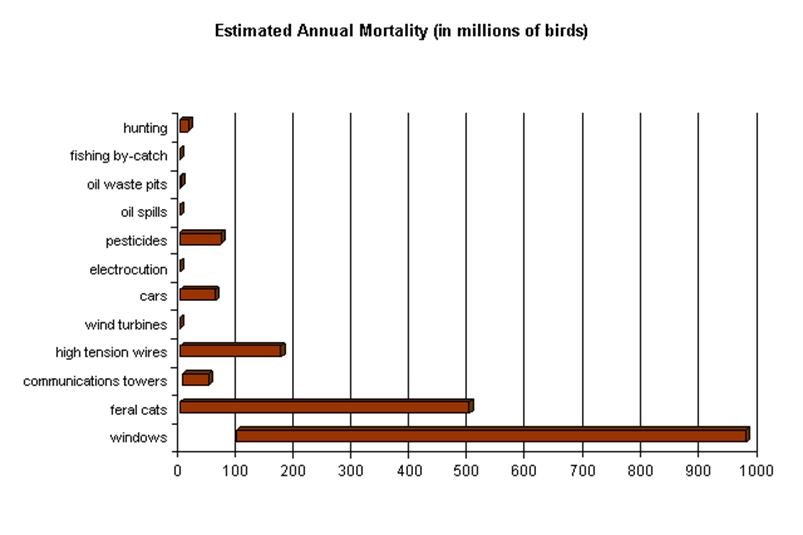
You can see that the number of wind turbine bird deaths were indistinguishable from zero on this scale, where the max is almost 1 billion. Since 2003, more wind turbines have been installed so more birds are probably being killed by striking them than are depicted here.
In short: windows and cats are killing birds.
Some other things also kill birds, including communication towers, electrical transmission lines, cars, and pesticides.
The other reasons for bird deaths that are not either windows or cats are very small by comparison, including wind turbines.
Let’s look at a more recent study, peer reviewed and conducted by five researchers- Thomason et. al- https://doi.org/10.1016/j.isci.2023.107274.
They gathered the carcasses of birds found dead near power lines in five western states to find out whether electrocution was the primary cause of death. They expected that it would be, but were surprised by the autopsy results conducted on the dead birds picked up near power lines between 2019 and 2022. This chart summarizes their findings:

I love charts! You should too! The statistical probability error bars send shivers of happiness down my spine!
The most startling result is that for both types of birds analyzed (raptors and corvids like crows and ravens), and for both high-voltage and standard pole power lines, gunshot wounds from illegal hunting were the leading cause of death. Among the 101 raptors where a cause of death was definitive, 72% were shot illegally by hunters. This was in the same part of the US where the original image was most frequently posted.
What does this prove? Well, only that a single image of a raptor under a wind turbine does not mean that the wind turbine killed it, nor does it help in understanding the role of wind turbines in bird deaths nationally or globally. So, here is another image:
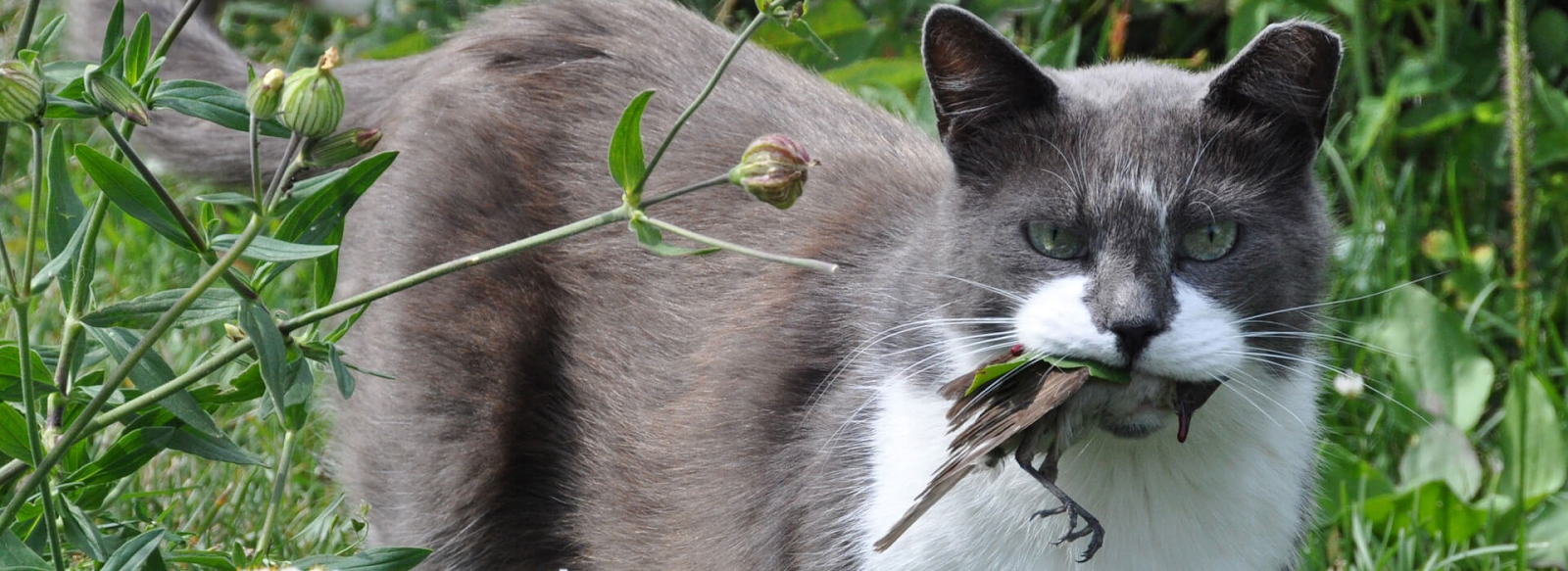
My caption: “If this cat were covered in oil, it probably wouldn’t have been able to catch the bird. And we would all be reaching for bottles of Dawn, which is gentle on both cats and birds.”
There does not seem to be any one authoritative source answering the question of how many birds die of what causes, as it is difficult to count and analyze dead birds at a large scale. There are no bird coroners who file reports with the US Government. So let’s pick two sources, because after a lot of doom scrolling, the major bird conservancy organizations seem to have drawn similar conclusions about the most important threats even though the exact numbers are elusive. I have selected the American Bird Conservancy, an independent non-profit, and the US Fish and Wildlife Service, an arm of the Government charged with preserving animals and their habitats.
The American Bird Conservancy (ABC) identifies these threats in order by severity:
- Climate change. It exacerbates other threats, such as habitat loss and habitat compromise. No specific number of animal deaths is provided.
- Habitat loss. They don’t give a number of bird deaths, but this also is considered a top threat, and appears to be the result of there being a lot of people living on the earth and of the warming climate.
- Collisions. ABC says glass is the big culprit, and cites the figure that up to 1 billion birds annually are lost to collisions with man-made objects. Of these, about half are collisions with buildings 11 stories or taller. Like the 58 story Trump Tower in New York. (The top floor is actually labeled “68th” but it isn’t. I’m not making this up; you can draw your own conclusions.)
- Cats. ABC says that cats kill over 1 billion birds per year.
- Pesticides. They don’t give a number of bird deaths. Recall that DDT almost drove bald eagles to extinction until Federal regulations, the good kind I’m sure, made it illegal.
- Fisheries. Overfishing kills seabirds, who need to eat the fish. ABC says that fishing long lines can kill 320,000 birds per year, and gill nets 410,000.
- Plastics. They don’t give a number of bird deaths. Plastic waste gets in the ocean and birds ingest it, or shorebirds get tangled.
The US Fish and Wildlife Service starts on their web page by saying that you can’t know for certain how many birds are killed and by what. But they have a more detailed table of their best estimate, which includes minimums and maximum estimates. My summary of it, with minimums and maximums, is as follows with references as cited to the studies used to derive the numbers.
- Habitat loss. They can’t even guess, but it is ranked number one. Remember that habitat loss, population expansion and global warming are related.
- Cats. Loss et al 2013a; 1.4 billion to 3.7 billion.
- Collisions with glass. From a Loss et al 2014a study; 365 million to 988 million.
- Collisions with vehicles. Loss et al 2014b; 89 million to 340 million.
- Poison. No source cited; 72 million.
- Collisions/ Electrical lines. Loss et al 2014c study; 8 million to 57 million.
- Electrocutions. Loss et al 2014c; 900k to 11.6 million.
- Collisions with communications towers. Longcore et al 2012; 6.6 million.
- Oil pits. Trail 2006. 500,000 to 1 million.
- Collisions with land based wind turbines. Loss et al 2013b; 140 thousand to 348 thousand.
I looked up the cited studies, and they state that while there is no single authoritative source for this information, the researchers looked at all available data to arrive at the upper and lower bounds. And of course because the wind turbine study is now 10 years old, the true range is likely higher.
In any event, there appears to be agreement that buildings and cats are the major threats to birds that can be quantified. Climate change and encroachment by people are uncountable but likely even more deadly. Most significant is that people are invading the space of birds in ways that disrupt breeding, food, and migration, resulting in more bird deaths than can be counted.
So (here I am rounding up to account for the passage of time), if you conservatively assume that buildings and cats account for about 4 billion deaths per year, and that wind turbines account for about 500,000, then there are around 8,000 birds that are killed by buildings and cats for each bird killed by a wind turbine.
While wind turbines do kill birds, buildings and cats kill thousands of times as many. So building fewer wind turbines will not materially impact bird deaths. But tearing down some tall buildings might help, as would killing a lot of cats. (Or training them not to eat birds, which in my opinion would be perhaps more difficult than herding them.)
Of course, it’s not really that simple. And we don’t want wind turbines to kill birds, even if they aren’t the worst thing that does it.
First, recall that some birds who die near power lines aren’t always killed by them, but by, for example, illegal hunting. This could also be true of wind turbines. We don’t know.
Second, not all bird species are equally vulnerable to collisions with wind turbines. Because of the way they fly and hunt, raptors are more likely to be killed by turbines than are smaller species. It is because the raptors are attracted to the same steady wind currents that attract the builders of the turbines. This is not true of glass buildings or cats. The extent to which this changes the numbers is hard to gauge.
Third, there are ways to design wind turbines that make them less deadly to birds, and newer ones are taking these factors into account. For example, painting the blades black has been shown to substantially reduce the number of bird collisions, as it makes the blades easier to see by the birds. Also, certain areas comprise known flyways for migrating species, and these can be avoided when deciding where to put them. So newer ones will be safer for birds.
An unexpected compensating effect of wind turbine design comes from a study by K. Shawn Smallwood, who developed an estimation model published in 2013 in the Journal of the Wildlife Society. He discovered that raptor deaths are inversely proportional to turbine size. So, as newer and larger turbines are installed, the rate of collisions with raptors (per kilowatt of generated power) should go down.
Fourth, if you don’t build a wind turbine but instead put a coal or other fossil-fuel plant in its place, this is not a free pass for birds. Coal mines, oil refineries, generating stations that use fossil fuels, and related wire and tower infrastructure destroys bird habitats, which as noted above, is a source of bird deaths. The emissions from a fossil fuel power plant introduces greenhouse gasses into the atmosphere, which results in heat changes that impact existing bird habitat. These changes are generally bad for birds. Emissions from fossil-fuel power plants also can include toxins that are deadly for the birds. The power plant itself would attract birds to their detriment, especially at night, given that the structures are tall and tend to be well lit.
I have to add one last point, which I am sure you have been eagerly waiting for. It is because the Facebook posting that got me started down this rabbit hole was from a conservative-leaning friend, with supporting “likes” and comments from other conservative-leaning subscribers.
Donald Trump, who sets the tone for many popular conservative issues, is on a multi-year rampage against wind turbines. (He calls them “windmills.”) A wind farm was built that is visible offshore from his golf course in Balmedie, Scotland, ruining the view (according to him). Trump bought the property in 2006 and opened Trump International Golf Links in 2012. Locals objected to the use of the property as a golf course, so he appealed to the Scottish national government (all the way up to the Scottish Supreme Court), bulldozed over local objections, and was able to start construction in 2010. This made him hated by the neighbors, of course. He did not realize when he bought the land that the power project had been approved three years prior to his acquiring the Scottish real estate; when construction of the turbines started, he was enraged.

He lost his fight with the Scottish authorities to stop construction of the wind farm, and apparently has harbored a grudge against wind power generation ever since. He claims repeatedly that wind turbine noise causes cancer (it doesn’t), they emit deadly fumes (they don’t), the towers will fall over (they don’t), they kill birds (although his administration undercut the Migratory Bird Treaty Act that protects birds from them), that they are manufactured by foreign companies (although his administration undercut Federal funding of wind energy manufacturing in the US), that they are ugly, and so forth.
Perhaps these claims have influenced the outrage over a picture of a dead bald eagle (which seemed actually to be a red kite) at the foot of an American wind turbine (which seemed actually to be in Spain). I don’t know. I do know that if we want to make a real dent in the number of birds killed by stuff, then we would have better results issuing cat hunting licenses, starting up cat training academies, and/or living in shorter buildings with fewer windows.
Maybe fewer cars would help, too, along with fewer electrical power lines. And oh, yes, fewer people living on the earth. I’m not volunteering to help reduce the population count, by the way. You will need to make your own decision on that point.
 Grandpa Dave Reads the News