Here is an interesting case that popped into my news feed this morning: a New Jersey woman, Judith Henry, was arrested in 2019 by Federal Marshals and held in the Essex County jail in Newark for a bit over 2 weeks, because a warrant had been issued for a different Pennsylvania woman who had the same name, and who had jumped bail in Pennsylvania 26 years ago. Ms. Henry was not released until she was transferred to a Pennsylvania jail where the officers took the 1 or 2 minutes required to compare her fingerprints to those of the actual criminal.
Ms. Henry sued pretty much everyone involved (there are some 30 defendants), claiming that she told them she was not the person they were looking for, and that if they had just taken a trivial amount of time to check her fingerprints (which they had on file in Newark), they would have confirmed that they got the wrong Judith Henry. Among other things, she claimed that because she was Black and Jamaican, the officers did not take her claim of innocence seriously.
In short: Ms. Henry was wrongly detained for reasons that could easily and quickly have been determined by any of 30 law enforcement officers. None of them bothered, including the Federal Marshals who served the arrest warrant. The six Marshals in the suit asked for the case to be dismissed against them on the grounds that they did their jobs as legally assigned and were therefore protected by “qualified immunity“; the initial judge didn’t dismiss it; so the Marshals took it to the Federal Appeals court which let them off, agreeing that they were just doing their jobs and were in fact entitled to qualified immunity. The rest of the case against the other 24 defendants and against Essex County still stands and will continue back where it started in Federal District Court.
This seems to be a case where the justice system was technically right, but justice was not served, in that no remedy is offered to Ms. Henry. Yet, anyway.
Note on how the news works: Most of the news stories imply that the entire case was dismissed in the ruling, which is not true. Dismissing the case when the police were clearly wrong is a much more compelling story than the real one. I know this because I read the actual opinion of the Federal Appeals Court judge. Where a story is more complicated than can be described in one or two simple sentences, you have to go to original sources to find out what happened. Most of us don’t have this kind of time. Oops. End of note on how the news works.
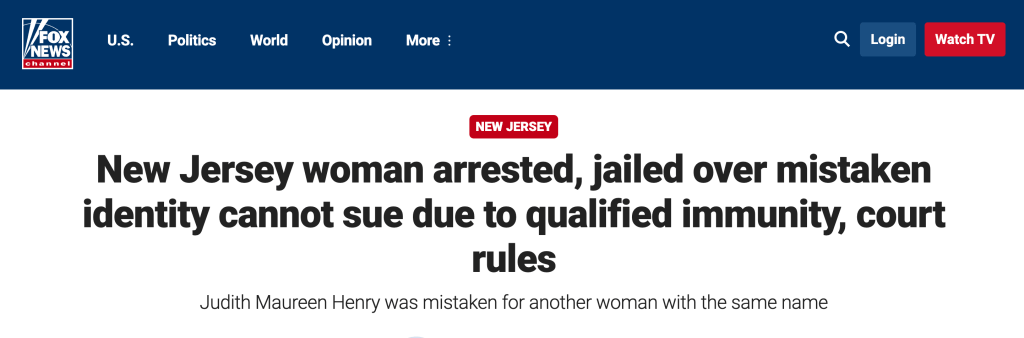
Regarding the text of the appeals court ruling – here it is, for reference: https://www2.ca3.uscourts.gov/opinarch/231987p.pdf. Legally, the key part of the ruling was “qualified immunity,” one of those concepts that are tagged as a “constitutional right” but actually was invented by the Supreme Court in 1967. It holds that law enforcement officers cannot be sued for doing their jobs. The Marshals who arrested and detained Ms. Henry had a legitimate and authorized warrant, including the wrong name, address, and picture. Since they were not the investigating officers in her case, they did not have an official obligation to do further detective work to confirm or deny the validity of the arrest. The judge notes that many defendants will claim to be innocent when they are not, and that it is not the job of the arresting Federal Marshals to ascertain whether those they arrest are lying.
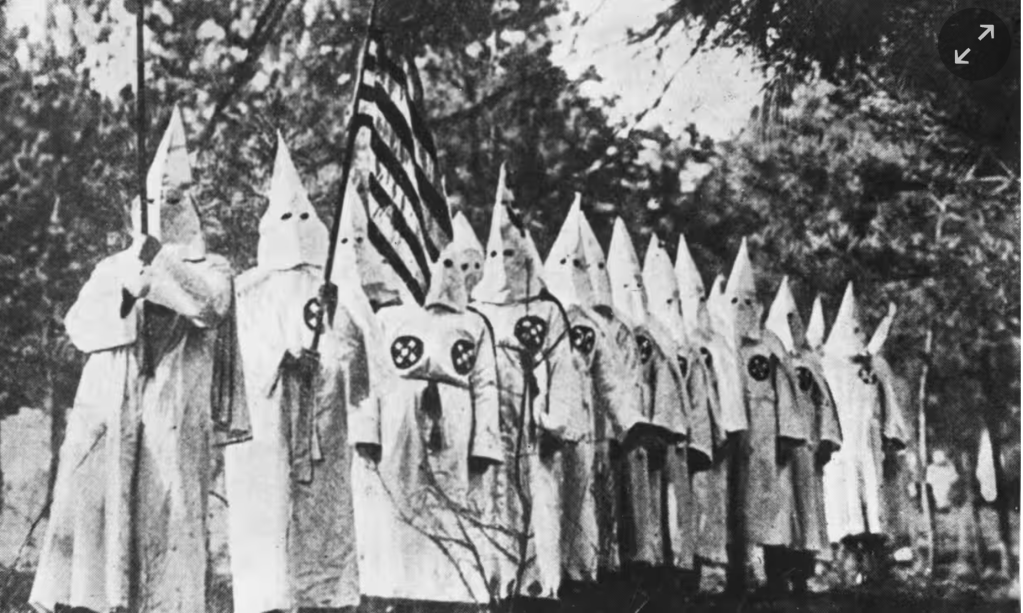
Historically, this aspect of the law goes back to the post civil war reconstruction era of 1871 when white police officers would beat, lynch, and kill recently emancipated Blacks with impunity. (Mostly) Southern Whites could not stand to see former slaves being treated as humans, and the ranks of the police were not immune to these feelings. In response, Congress passed the Civil Rights Act of 1871, or 42 USC 1983. This law, for the first time, allowed private individuals to sue the police or other authorities if their constitutional rights were violated.
This law held firm until 1967, when it was essentially overturned by the Supreme Court. I guess the Justices thought it was now ok for the police to beat up Black people? I wasn’t there, so this is just speculation. The Supreme Court can be inscrutable at times. It was the height of the Black Panthers movement and, of course, hippies, electric guitars, the Beatles, and free love. Perhaps I will come back to this in a later post, but I was 17 and, well, I was 17. Let’s leave it there.
Qualified Immunity was the outcome of the decision in the Supreme Court case Bivens v Six Unknown Named Agents (1967). It held that law enforcement officers could only be subject to lawsuits if they violated certain specified constitutional rights of the plaintiffs, thus restricting the ability of private citizens to sue the police for false arrest, beatings, and whatnot. Federal Bureau of Narcotics agents raided Mr. Bivens’ home and arrested Mr. Bivens, even though they had no warrant authorizing the raid. Mr. Bivens sued, it was appealed to the Supreme Court, and this case let the Feds off the hook.
The Bivens ruling was clarified in Harlow v. Fitzgerald (1982), because the original ruling required that the state of mind of the police officer be considered, which was generally difficult to ascertain. Harlow ruled that the official would be liable in a civil suit only if a “reasonable person” in the same position would have known that the actions were not in accordance with the law. The judge in the Essex County case did not buy that the six Marshals acted outside the law, or that any other Marshals would have done anything differently.
The judge also dismissed Ms. Henry’s claim that, in effect, had she been white (or white and wealthy), the officers would have taken her plea of innocence more seriously, quickly checked her prints, and let her go right away. The judge ruled that Ms. Henry provided no evidence that racial bias was a factor in the 2 week delay.
How would anyone in these circumstances provide evidence of racial bias? Judith Henry could be right, but the judge is, in my opinion, asking for an impossible standard. Just because the Marshals didn’t say in their legal brief that “You were a Black woman, so we assumed that you were guilty,” doesn’t mean that it didn’t happen. No one in their position would ever admit to this. (Although in their defense, the Klu Klux Klax was pretty upfront about their goals and beliefs.)
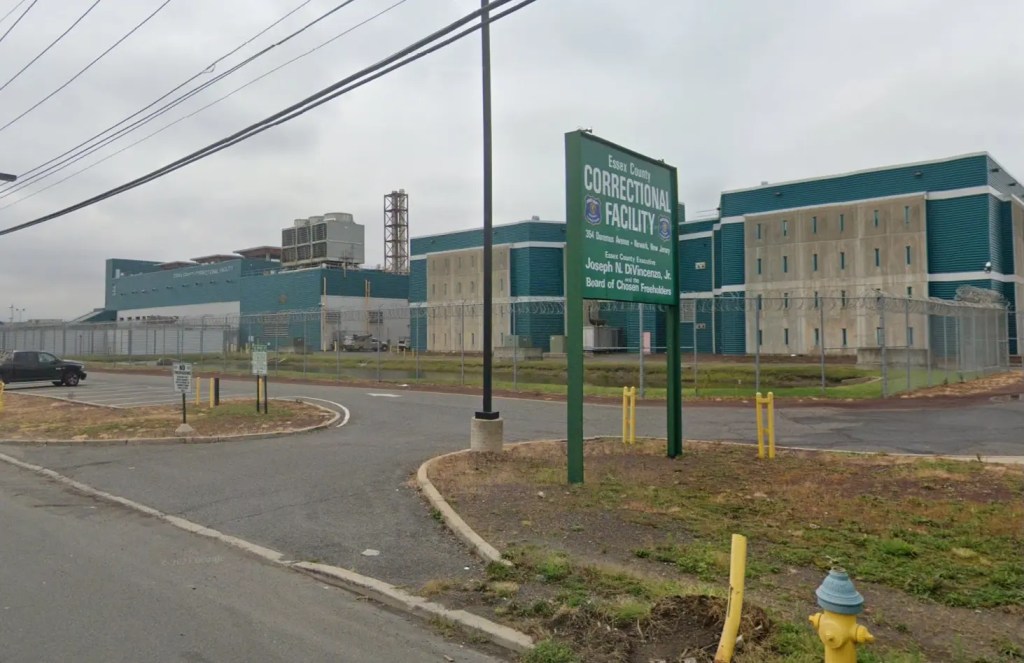
This story hits a personal note for me, because I became friends with an older man who spent 20 years as a guard at this very same Essex County jail. He recently passed away – he was in his 90s and life caught up with him. He had a senior position at the jail, responsible for training the newer guards. I asked him one day about the guilt or innocence of the prisoners at Essex County, and his reply (I am quoting him on this) was: “If the police arrest them, then they are guilty.” He was quite clear on this point, and probably represented the majority view of Essex County jail guards at the time he worked there.
This is, of course, not the view of our Constitution.
Obviously, my friend was not involved in the Judith Henry situation. But it sets a context for the facility she was held in, where no one would bother to take the one or two minutes required to check out her claim that they had arrested the wrong person. Stay tuned for further updates on this case.
 Grandpa Dave Reads the News
Leave a comment