Quality and manufacturing were in the news today, bringing me back to the olden times 10 years ago when my job was walking factory floors and observing whether things were being done in conformance to approved manufacturing procedures. It’s Boeing that is in the news about this, of course. The process word of the day is “traveled” work. To “travel” a part or assembly means to move it along to a future stage of production even though, as manufactured, it does not conform to specifications.
For the record, if one of my clients “traveled” a part I would write them up. It would be a clear violation; repeating it could lead to shutting down the plant.
Parts or assemblies that do not meet specifications are supposed to be clearly marked or tagged with appropriate information about the defect, and set aside in a designated containment area. Records of these events are required so that the repair can be confirmed.
Apparently, allowing “travelled” parts was de rigueur at Boeing. If something could be fixed further down the line, the line kept going. This sounds good, right? Go faster? The problem is that these things pile up, and they don’t always get fixed correctly when they are moved to another factory where the workers are not as familiar with how that particular part goes together and by then have other things to focus on.
This was evidently a key factor in the Alaska airlines “missing bolts” incident, resulting in the door coming off of a 737 Max in mid-flight. A problem with the door assembly was observed in the Wichita plant where the fuselage was manufactured, but instead of fixing it, it was tagged as a “traveling non-conformance” and shipped, defective, to the Renton, Washington final assembly plant. The managers at the Renton plant were, I guess, in a hurry because they could not bill the customer until the plane went out the door. The employees working on the defective door assembly must have been told to finish quickly, and so they failed to put the door back correctly after dealing with the “traveled” problem. Boeing has not been able to find the repair sign-off record, so it looks like the hastiness involved recordkeeping as well as repairing.
Boeing’s CFO Brian West yesterday announced at a Bank of America investors’ meeting that their factories would no longer allow “traveled” work. In other words, they allowed it before. This will include shutting down two “shadow factories,” facilities that are not part of the regular process but are maintained just to repair defective parts that were made wrong and shipped anyway. It’s what Deming was saying 50 years ago; not doing it right the first time will eventually cause it to take longer, it won’t get done correctly, and it will cost more money.
Deming’s philosophy, now apparently being embraced by Boeing’s CFO, is a hard pill to swallow for this company. Not shipping defective parts is slowing down production, creating the appearance at Boeing of a huge cost hit, on the order of a $4 billion free cash flow reduction. I’m not making this number up. In other words, slowing down initially to allow employees to figure out how to get things right the first time looks to American management like a giant financial disaster.
This is the soft underbelly of American capitalism.
As we all know, this last week celebrated “Pi Day,” or March 14. Since this date is written 3/14 and pi is roughly 3.14, this date is set aside for reflection on the world’s favorite irrational number.
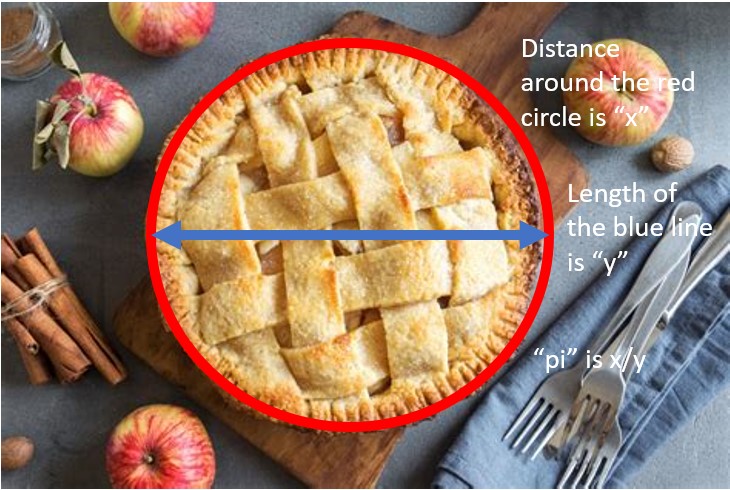
What is pi exactly again? It’s the ratio of the circumference of a circle to its diameter, which I have deliciously illustrated below:
The fact that this is an interesting number was known even in ancient times, as shown in the Bible. For example, in Kings 7:23, King Solomon describes the process of building the Temple of Jerusalem (my research indicates that this occurred around 760 BCE) and includes this royal observation. Solomon brought in Hiram, an expert in working brass, to do this part:
“He made the Sea [or washing basin for the priests] of cast metal, circular in shape, measuring ten cubits from rim to rim and five cubits high. It took a line of thirty cubits to measure around it.”
Since a cubit is somewhere in the neighborhood of 20 inches, the “sea” was around 17 feet across. Wow! Big! Anyway, I decided that I should do an experiment to find out whether 30 cubits / 10 cubits was really the value of pi, given that this metal representation of the sea is in the Bible and all. Solomon is saying that a circle has a circumference of 30 and a diameter of 10, or that pi is equal to 3. Let’s try and find out.
So I started with a pencil, a piece of paper from the kid’s easel in the basement, and a Calphalon 10″ saucepan. (These saucepans are fantastic! You can bake stuff in the oven in them and everything. You can see that mine has been loved.) Here is the setup:
Using the pencil, I traced the circular shape of the pan on the paper. Next, I used a string to measure the distance around the circle and taped the string to the paper:
I can use the length of this string to measure the circumference of the circle. Let’s say this distance around the circle, and the length of my string, is 30 cubits. I next took the string off the paper, and folded it exactly into thirds, and cut a pink pipe cleaner to the exact length of one-third of the string. Voila! We have a 10 cubit pipe cleaner.
I now had a way to compare my 10 cubit pipe cleaner to the 30 cubit distance around the circle. If King Solomon was correct regarding the measurement of his model of the sea in the Temple, then the pipe cleaner should be exactly the distance across the circle, confirming that the value of pi is 3. Just like in my picture of the delicious apple pie at the start of this piece. I re-taped the 30-cubit string back to the circle and placed the 10-cubit pipe cleaner directly across the center.
Here is the result:
Oh, no!
No matter how I set the pipe cleaner across the circle, it sticks out of one side. If the relationship of the circumference to the diameter were 3:1 as described by the wise King Solomon, then it should have fit exactly. So I guess that pi is not 3.
At this point I feel that I literally owe an apology to any of you who thought that everything in the Bible was literally true. Clearly, King Solomon was literally wrong in his description of this part of the Temple, and also was being literally untruthful to Christians regarding a basic characteristic of the world, in this case regarding the ratio of the circumference to the diameter of a literal circle. (See how I am literally having some fun at the expense of Biblical literalism?)
So, pi must be a little bit larger than 3. But, how much larger? How can you know? I enlisted my grandkids in the pursuit of the truth. And who wouldn’t? There is great truth in the young.
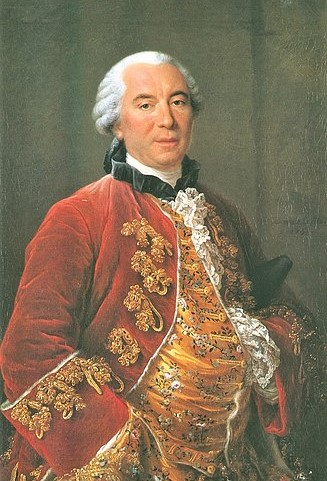
For this experiment, I reached back to the 18th century and to Georges-Louis LeClerc, the Compte de Buffon. (In English, that means that he was a Count, and gifted mathematically just like the titled muppet on Sesame Street.) Here is a picture of him.
He posed the following mathematical question, often referred to as the paradox of Buffon’s needle: suppose you have a floor with stripes of equal width, and drop a needle randomly on it. What is the probability that the needle will lie across the boundary between the stripes? It turns out that if the stripes are the same distance apart as the length of the needle, then the probability is 2 times pi.
OMG! This means that we can derive the value of pi by dropping elongated things at random on a surface properly marked with lines the length of the thing, and after some number of drops, the ratio of things dropped to things crossing lines will approach a multiple of pi. Divide by 2, which my grandson David knows how to do, and we are home free. I chose to drop hot dogs on a table, enlisting the kids to do the dropping so that it would be highly random. And I let them use calculators.
I started by buying an 8-pack of Boar’s Head gluten-free hot dogs and measuring them. I thought Boar’s Head would work well, and would taste good later. According to their manufacturer, they deliver exceptional flavor and a superior bite with a “snap.” Here are the results of my measurements:
Note that the hot dogs are not all the same. It’s part of what makes them so good! On average, the 8 in the package that I bought were 13.6875 cm long. I took a long roll of paper and marked lines every 13.6875 cms, or as close as I could get to it.
Next, the kids took turns dropping the dogs onto the paper. Here is John taking his turn, with his mom looking on for encouragement:
Each of the three grandkids had their own approach to the task. John tended to drop them with a flourish, while David would toss them more assertively so that we usually had a few “out of bounds.” James mostly just dropped them.
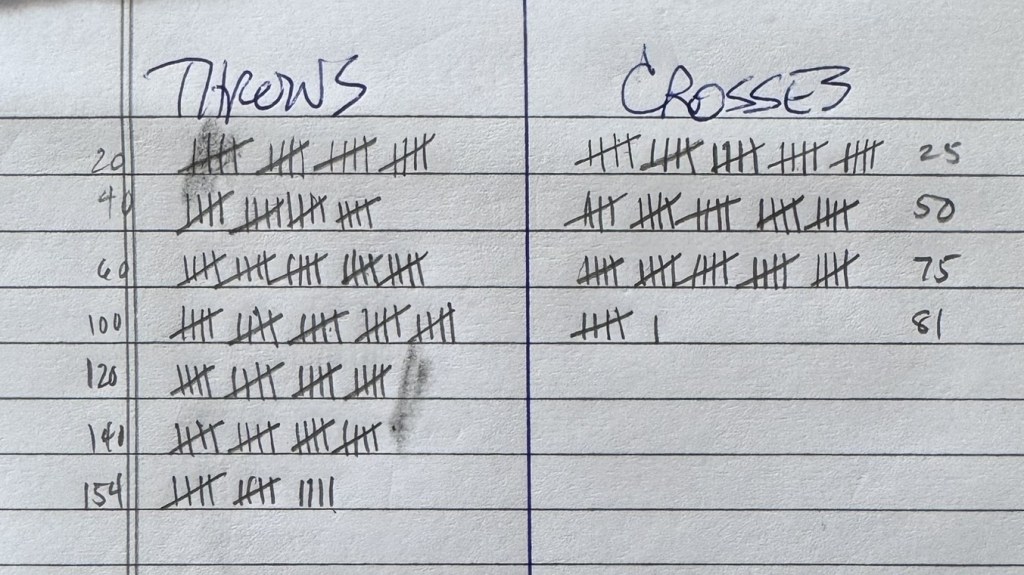
The results:
The totals on the outer columns were preliminary and turned out not to be consistent with the hash marks. Science! Things go wrong! There were 140 total hot dogs dropped (based on recounting the hash marks), with 81 of them crossing between two stripes. Plugging this in to the formula (2*total number dropped)/(crosses) yields the value of 3.45679 for pi. This is about a 10% error, but given the limited attention span we all have for science, it is a fantastic result.
I personally think that our answer was better than the actual “pi” since the first five digits are 3,4,5,6,7 which are a heck of a lot easier to remember than 3.1415.
In search of a better way to figure out the value of pi, I decided to turn to AI for a more modern approach. As we all do these days.
Given that I have a free account on ChatGPT, the world’s most famous AI chatbot, I logged in and asked it to “please calculate all digits of pi.” This was, of course a trick question! It is impossible to calculate all the digits of pi, since pi is an irrational, non-repeating number that has an infinite number of digits. Falling for the trick, I got this answer:
“Calculating all digits of pi would require a significant amount of computational resources and time, especially if we’re aiming for a high level of precision. While it’s theoretically possible, it’s not practical to do it in a reasonable time frame on a standard computer.“
Ha ha! After the laughter subsided, I asked it to write me a computer program that would calculate the value of pi. I got this answer, written in the programming language Python:
Not bad for a robot that thought it was theoretically possible to calculate all digits of pi. This program is sort of the computer equivalent of throwing hot dogs on the dining room table; it puts dots (think of them perhaps as M&Ms) at random locations inside a square, and then counts how many of them happen to fall inside one quarter of an inscribed circle. This turns out to be an approximation of pi! Who knew?
It starts by asking how many M&Ms you want to drop. So, I ran it with 140, to see how close our robot overlord would come to the answer I got by enlisting my grandkids. The answer: 2.914285714285715. I will let you do the math regarding who did better. I hope it’s the kids.
Thank you for reading this far. You deserve to treat yourself to a hot dog. Come back again for next year’s celebration of pi day, when I hope to get to the bottom of how best to make pi with ingredients that you might find in your kitchen.
Chief Justice Tom Parker last week ruled on behalf of the Alabama Supreme Court that all fertilized human embryos are children. The case arose because a man at a Mobile, Alabama IVF clinic accidently dropped a vial of cryo-frozen fertilized eggs, destroying them, and the parents from whom they came sued the clinic under Alabama’s “wrongful death of a minor” act. Judge Parker ruled on the appeal from a lower court that the embryos, or “extrauterine children,” as he called them, were subject to this particular law and therefore the clinic was to be held responsible for the children’s wrongful death. The ruling can be found here: https://tinyurl.com/ycydv35p, with Judge Parker’s concurrence starting on page 26. Here is a quote from his ruling, where he is talking about whether IVF procedures should be an exception to the Alabama state law defining unborn embryos as children:
“Carving out an exception for the people in this case, small as they were, would be unacceptable to the People of this State, who have required us to treat every human being in accordance with the fear of a holy God who made them in His image.”
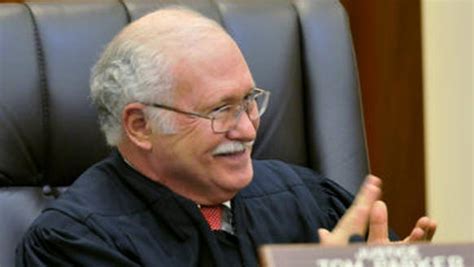
Here is Judge Tom Parker, whose ruling gives preference to his Biblical beliefs over the US Constitution. In Alabama, the majority apparently agree with him, illustrating De Tocqueville’s concern about the “Tyranny of the Majority.”
Naturally, if this ruling becomes more widespread, then IVF would become impossible. Technically, although it might not be illegal, no U.S. clinic would want to take on the potential liability. Notably, he quotes the Bible copiously in his ruling.
We all recall the Bible passage in Matthew (or was it Revelation? I may have forgotten) that says that “Behold thee, ye microscopic fertilized but not implanted eggs, which you cannot see, for they are in thy mother’s womb, or perhaps they are not; they are all God’s children and their destruction is the sin of murder.” (OK, just for the record I made this up.)
NPR’s “On the Media” recently ran an interview with Matthew D. Taylor, an academic who studies Christian extremism. Taylor reports that judge Parker is a member of a group calling itself the New Apostolic Reformation, or NAR. A central tenet of the NAR belief system is that God has given them a mandate to dominate (that is, take control over) the seven aspects, or “mountains,” of US society, which are family, religion, education, media, entertainment, business, and government. Yup, seven. Judge Parker is diligently climbing the government mountain.
“Appeal to Heaven” flag originally flown by George Washington and now considered an emblem of the NAR, as the flag predates the ratification of the Constitution and is a quote from John Locke. Michael Johnson, the House Chair, flies one outside his office in the Capital. This one is being displayed by adherents attempting to illegally overturn the last US Presidential Election.
NAR cites Revelation 17:1–18, verse 9 which reads, “And here is the mind which hath wisdom. The seven heads are seven mountains.” I did not make this verse up; you can read all of revelation 17 for yourself if you don’t believe me, although I would not recommend it. NAR believes that dominating all aspects of cultural and national leadership, and converting these parts of America to adhere to the NAR’s religious beliefs, will usher in the apocalyptic end times. They call this their “seven mountain mandate.”
Does this sound like a good idea to you?
Parker is not the only member of our government who ascribes to the seven mountain mandate – Mike Johnson, the current House Speaker, is also on board, as are several other members of Congress. They want to change the US Government away from our current Constitution so that it conforms to (their) understanding of the Christian Bible.
While I certainly am not a Biblical scholar, my reading up on this passage informs me that Revelation 17 describes the end times war between God and the idolatrous, or sinful, governments of the earth. A woman harlot and the beast represent the Satan-powered evil governments who rule over earth, but then succumb to Jesus in his triumphal second coming. After God gives four angels the temporary power to destroy everything. The seven mountains are thus to be dominated so that this prophecy can be fulfilled, the earth can be almost destroyed, and Jesus can return to rule on earth to live gloriously with the saints that are still remaining. The NAR must believe that they will be among these remaining saints. I wish I had made this part up, but sorry, no.
So, the NAR followers are on a Holy War to take over everything and drive out Satan from amongst us. Because of the high stakes of this perceived Holy War, where God is in the final battle against Satan, they are not interested in compromise. And since one of the NAR beliefs is that life starts at conception, Judge Parker feels pretty comfortable ruling that dropping a cryo-frozen fertilized embryo on the floor is murdering a child.
But wait! There’s more!
There was plenty of talk in the news about IVF as a result of this judicial ruling. But, it also got me thinking about the process of conception, and how life starts. Judge Parker, recall, believes that life – or humanity – begins when an egg is fertilized. However, biology doesn’t work that way. The medical consensus is that pregnancy starts at the implantation of the fertilized egg into the uterus, which is typically a few days following fertilization. Here is a short but ranty video by Bill Nye, the Science Guy. https://tinyurl.com/y4v3cpvh.
He points out that whenever a couple goes forth to multiply, some eggs are fertilized naturally by the process that do not implant in the uterus and therefore do not become children. The number of fertilized eggs that result from the “going forth to multiply” process is somewhat random. If, for example, two of the fertilized eggs successfully implant, then you get twins. The fertilized but not implanted eggs are naturally eliminated from the woman’s body as part of the normal process. It has always worked this way, even in Biblical times.
I have looked at a number of other sources of information about how babies are made, and what Bill Nye says is true. For example, according to the UCSF Center for Reproductive Health, about half of all fertilized eggs are lost in the normal process of conception.
This means that, according to Judge Tom Parker, you can’t get pregnant without murdering a lot of children. Or to put it another way, the Alabama law – and his ruling – make every mother a criminal, and make motherhood a crime. When Judge Parker figures this out he will be shocked. Let’s not tell him.
Today is another OMG! story! Last September I noticed that my Medicare statement included a payment to a “Royce Medical Supply LLC” for 400 intermittent sterile catheters. Which I don’t use and did not receive. These were ordered in bulk, totalling almost $4,000 which Medicare had already paid to Royce. (I’m not going to explain what an intermittent catheter is; you can look it up.) I immediately called the Medicare Fraud number and had a long conversation with a nice agent who told me that she would sent a note to someone about it, and agreed that, yeah, it kind of sounded fraudulent. I then called UnitedHealthcare, my supplemental insurance provider, who said that Medicare had approved the payment, but that she would also send an appropriate note to someone else in the company. I was told by Medicare that people who report fraudulent transactions like these don’t get any follow-up notification, and I hadn’t heard anything about it since then.
Until this morning. Here is a screen grab from my Medicare statement:
A screenshot of my Medicare statement showing the claim and payment to Royce. The supporting detail indicates the charges are for 400 “Intermittent Urinary Catheters, with Insertion Supplies” in two orders, one on 7/24/23 and the other 8/23/23. Because Medicare approved the catheters, my secondary insurance was responsible for the $744.
Both the New York Times and the Washington Post today reported on a fraud investigation underway involving Royce Medical Supply at the exact same address in Ft Lauderdale that showed up on my catheter order, 2950 W Cypress Creek Rd. What’s more, this is the biggest fraud ring that has ever been pursued on behalf of Medicare, amounting to about $2 billion in total fraudulent payments. There are alleged to be seven companies in the crime ring and they all billed for bogus intermittent catheters, apparently because this is something that typically does not get much attention by the Medicare auditors.
Although in this case, the giant spike in one product, all from a small select handful of companies, should have raised some eyebrows at the Medicare fraud desk. Especially given that I can’t have been only one to notice, although I will say more about this later.
The pattern seems to have been that the criminals legitimately purchased companies that already had licenses to bill Medicare for durable medical equipment, referred to in Medicare lingo as DME. Every company involved in the scheme was purchased in 2023 after being run legitimately before then. This avoided red flags based on the billing service provider, and gave the gang access to Medicare’s billing system.
How they obtained my Medicare ID and related information is a mystery. I had not done business with this company, or any of the seven, so they didn’t get my name from their own records. They must have stolen my Medicare ID, or obtained it from someone who did.
The Washington Post journalists interviewed Dara Corrigan, the head of the Medicare Fraud Prevention group. Corrigan declined to give any specifics regarding the state or scope of the investigation, stating that divulging any information might compromise an investigation that might or might not be ongoing. Ditto for FBI.
According to the Post, “The alleged scheme was uncovered by the National Association of ACOs (Accountable Care Organizations).” NAACOS is a non-profit trade group that represents hospitals and providers across the country. This role gives NAACOS access to Medicare records that enabled them to notice the seven companies that suddenly started a massive (and obvious if you were looking) billing spike. The Post and the Times reporters interviewed Clif Gaus, the NAACOS CEO. While NAACOS may have been the first accredited agency to report it, I am sure that many other individuals reported their claims as fraudulent. At the time I did a quick Google search for information related to my transaction, and there were plenty of people who had reported Royce to the Better Business Bureau with similar complaints, many of whom I am sure called Medicare also.
According to the NAACOS analysis, about 450,000 patients were billed for these catheters in 2023. Normally, Medicare gets about 50,000 billing transactions per year for them. This suggests that 400,000 billing transactions like mine were probably paid by Medicare as part of the scheme.
The Washington Post was able to contact the former owner of Royce Medical, who sold their business in 2023. She stated that this was a big problem for her. Even though she had nothing to do with the fraud – it all occurred after the new owners took over – customers were blaming her for the billing.
I know I did the right thing to immediately report the Royce bill to the Medicare Fraud Desk, but the response I got from Medicare was both unsatisfying and frustrating. I told them that I had not ordered the items, and it was almost as if they didn’t believe me. I thought at the time that if I was billed for this, it was unlikely to be a one-off event, and that there had to be a giant pile of similar complaints that were blinking red lights at the agent that I spoke with, who was part of the fraud prevention group. I have no way of knowing. I can hope that when fraud is this obvious, that our government jumps right on it. Which they may have. It’s hard to know.
Now let’s talk about how the news is reported. And mostly, I mean how they draw graphs! It would appear that the NAACOS people sat down with both the Washington Post and the New York Times reporters, explained what they had come up with, and shared the numbers. Here is how each of them drew their graphs illustrating the same data trend.
First, the Times online version:
This is the New York Times version of the NAACOS data, from 2021 to the most recent quarter.
And here is the Washington Post online version:
The Washington Post graph of the same data
And here is the version of the same data as shown in the print edition of the New York Times:
The Washington Post wins!! I did not expect this, but ok. They both correctly attribute the underlying data to NAACOS (and yay for honesty in journalism). Both versions correctly show zero-origin axes with appropriate scaling, and correctly label the vertical and horizontal. The Times online version includes dots that are distracting from the message, and leaves you to guess the peak medicare fraud amount. The printed version of the same plot in the Times shows the jump in a way that appears to be way more startling, so I will leave to you which one is the most “accurate.” The Post, on the other hand, uses shading to highlight the message about how out of proportion the billing is, omits the distracting dots without any loss of clarity, indicates the amount (nearly $1 billion), and adds an explanatory text that provides context for the figures.
This leaves me thinking that there are two remaining problems related to Royce billing my Medicare account.
One problem is that even if the money for my order went to Royce, I have no out-of-pocket liability. This gives me, and other older Americans, little incentive to pursue these sorts of claims. The Post journalists were told by their interview subjects that most people don’t read the detailed medical statements they get, allowing this type of fraud to go on longer than it should. Given that I did not experience any out-of-pocket loss because of Royce’s use of my information, was I really a victim? It’s an existential question like the one about a tree that falls where no one hears it.
A second problem is that I have no idea how Royce Medical was able to obtain my Medicare billing identification information. I now read the monthly statements very carefully, looking for evidence of providers that I do not know, or billing transactions that seem unfamiliar.
Today’s Obituary was for David L. Mills, the inventor of the Network Time Protocol (NTP). He was one of the original ARPAnet engineers, the original US Government design experiment that became the Internet we now know and love. NTP was the solution to an important engineering problem of the nascent Internet, which was: every computer had its own clock, and time differences would cause data to go the wrong way or otherwise be misinterpreted on the new network. His invention of NTP synchronizes clocks on a variable-lag network to within a few milliseconds of each other. The Internet as we now know it and use it could not exist without this invention. He was known as “Father Time.”
Here is a bit about his invention. NTP is implemented on dedicated computers that work in strata (or layers), where stratum 0 is a set of atomic clocks (including some that orbit on satellites); stratum 1 are the computers directly wired to the atomic clocks; and stratas 2 and higher are connected via “laggy” networks in a downward cascade.
Each computer in the downward cascade performs elaborate calculations to average out the amount of time it takes information to reach it from the other NTP computers, using complex math to arrive at a very close approximation to the time reference of the atomic clocks at the top of the pyramid. Windows (the software that runs everything) automatically synchronizes to this time system, so that our robot overlords hum along nicely.
The NIST F2 cesium fountain atomic clock, shown here with engineers pretending to fiddle with it. It uses the resonant frequency of cesium atoms to create a frequency reference, which then magically becomes the time. It would run for 300 million years without losing even one second.
One interesting fact about the protocol is that all time originates at midnight January 1, 1900 and is represented in a 64 bit number by the number of seconds (32 bits) and fractions of a second (another 32 bits) since then. The largest number that can be represented in 32 bits is (of course you knew this) 4,294,967,296. This means that Internet clocks have been counting up the number of seconds from January 1900 to now, so that each second and fraction are unique. When the maximum value is reached, what happens? The number rolls over to zero, which would be bad. Very bad.
At this point I hope that you are all getting out your calculators to do the math to answer the question: when will this blow up?
It turns out to be at 12:00:00001 am February 7, 2036. Not that long from now.
You can’t really blame David Mills for this, since he came up with the protocol in 1981 to support a network of maybe 2 dozen computers that were strictly a government experiment. And in his defense, NTPv4, the current version, has two 64 bit elements, which ought to be fine. Really. As long as we can upgrade every computer on earth between now and then.
So, we are mourning the loss of one of the key inventors of the technology that is now the Internet, or “Interwebs” as I like to call it. What is the status of some of those others who helped Mills blaze this path? I’m glad you asked! Here is a reckoning of some of the most noteworthy:
Larry Roberts: Roberts headed up the ARPA net project initial implementation. He’s dead.
Paul Baran: One of the two scientists who independently came up with the idea of a packet network. It’s total genius! I think you just have to trust me on this one. He’s dead, too – in 2011. If you would like me to explain packet switching vs circuit switching, just ask, but be forewarned.
Bob Metcalfe and David Boggs: Metcalf came up with the ‘ethernet’ protocol, which enables computers to inexpensively and reliably connect to each other locally (in the same room or building) even when the wire or communication among them makes mistakes and sends the wrong number of volts. Metcalf is 80 and still kicking (he went on to found 3Com), but Boggs, his partner who was the implementing engineer of the first ethernet circuit, just died this year.
Vint Cerf and Bob Kahn: These two in 1974 invented what we now call TCP/IP (for this one, please just don’t ask, really), which allows apps to talk to each other reliably, even when the network is faulty and tries to introduce errors in the transmitted information, or delays or drops some of it. Cerf is 81 today; Kahn is 86.
Tim Berners-Lee: He is a British computer scientist who first came up with the idea for what we now call a “web page.” A lot of people think that this is the Internet. At 68, he is a youngster and still expresses his opinion when someone tries to ruin the Internet.
Paul Mockapetris: Paul was one of the original internet engineers at the University of Southern California in the ARPA days. When the network became too big to manually set each individual computer to a numerical address, he came up with the DNS idea. These are the “something.com” names that we are all familiar with. Born in 1948, he was a youngster at the time and is still with us.
Al Gore: Poor Mr. Gore is ridiculed by conservatives and climate change deniers who think that he claimed to have invented the Internet. He’s only 75, so we probably will have him to kick around for a while longer. In any event, he was a pioneer among US legislators who, in 1991, put together and passed a bill that funded much of the innovation during that time, including funding for the University of Illinois research group where…
Marc Andreessen invented the first web browser, called Mosaic. Internet Explorer, Edge, Chrome, Firefox, and many others are now available. Back then, though, Mosaic led the way. Because taxpayers paid for the staff and resources involved, it was offered free to anyone who downloaded it. Marc, born in 1971, is a youngster and is still with us. In fact, he’s a gazillionaire.
Bill Gates: Mr. Gates had nothing to do with the invention of any part of the internet, but he took a small piece of software (which he did not write) and turned it into one of the biggest and most profitable companies in the universe. Bill Gates represents the American dream. I just thought you would want to know.
That’s about it for David Mills and the invention of NTP, or the Network Time Protocol. So, what time is it, again?
Oh, gosh – I turned to One America News (“OAN”) this morning and bumped into a story by OAN’s Pearson Sharp stating that Democrats have a long history of claiming voter fraud, making them just as dishonest as the Republicans. I’m not sure why “being just as dishonest as the other guy” is a good thing, but, anyway, that was the sales pitch so let’s continue. Sharp’s “long history” claim is supported by one primary incident: Jimmy Carter’s run in 1962 for the Georgia state senate. The opinion journalist’s conclusion is that Trump is justified in claiming voter fraud because “the Democrats” have repeatedly made the same claim about Republicans.
Here is the lead-in to the Sharp OAN story: “Democrats have a long history of not only contesting elections they lose, but blaming voter fraud and even demanding the elections be overturned. One America’s Pearson Sharp reports.” Mr. Sharp’s argument is outlined below, on the left. The comparison to Trump is unstated in the OAN piece so I have taken the liberty of stating it.
Carter Situation
Trump Situation
Carter claimed voter fraud in one district, went to court
Trump claimed widespread national voter fraud by Democrats, brought 60 court cases
The Georgia State Court looked at evidence, concluded fraud had occurred in the one district
60 courts looked at evidence, concluded that no fraud had occurred by Democrats (or anyone) in any of the cases
Court: Fraud committed by Carter opponent
Court: No evidence supporting fraud by opponent
Recount ordered, resulting in overturning of prior result
Recount(s) ordered, no change to outcome of election
Mr. Sharp concludes from this that Democrats are just as guilty as Republicans in both fraudulent activity and in claiming the other guy cheated. Lots of additional innuendo that both sides are equally dishonest. Even though, in the Carter case, only one side was dishonest – and it was not Democrat Carter – although Sharp does not mention this.
The last part of the report is a litany of cases where Democrats have complained about Republicans who commit voter fraud. He goes through these so quickly that you have no idea what really happened, just like the Carter 1962 reference earlier. The result is that you are left with the impression that Trump’s complaints about the Democrats must also be legitimate. Please stop for a minute and think about this logic: a) my party commits election fraud; b) your party complains about it; c) therefore, my complaints are legitimate. Sharp, of course, does not give you time to think about his logic; he moves quickly with his monologue.
If conservative media sources like OAN were my only source of information, I would think that the deep state is out to get Trump, and that the Democrats have a history of unethical behavior. Pearson Sharp has a very compelling TV persona, and presents the story with a high degree of self-confidence. How could someone so sure of himself be wrong?
The Carter story is not what you’d think from Sharp’s quick recap; it turns out not to have anything to do with Democratic vs Republican politics.
Carter, in his first election to public office in 1962, ran for a seat on the Georgia state senate. On election day he was traveling to each of the Georgia county polling places when he observed a local political boss pulling Carter votes out of the ballot box, marking ballots for the other guy, and generally doing things to ensure that Carter would lose in tiny “deep south” Quitman county. This was evidently not surprising to the people who lived in Quitman County, as the local boss doing this was well known for these tactics. Carter complained to the local election officials, who ignored him, as they were friends with the local boss. He then went to the state officials and to the Atlanta newspapers, and the rest is history, since the evidence of ballot fraud was overwhelming, and a recount showed Carter to be the winner by a landslide. It is a story, not about Democrats or Republicans, but about standing up to an entrenched culture of political favoritism. Party affiliation was irrelevant.
This experience gave Carter a reputation for honesty and integrity which stayed with him for the remainder of his long political career.
So, what was that One America News thing about again?
I thought you might be curious, so here is a link to the OAN story which you can view, and then decide for yourself:
This morning I thought I would read transcripts of recent Trump and Biden campaign speeches, and attempt to summarize what they actually said they would do if elected, as opposed to what they are saying about the other guy, or what the media is saying about them.
I found a transcript of a typical Trump speech given three weeks ago in Reno. I have tried hard to ignore any insults, name calling, or other statements that seem untrue, meaningless or misleading. So, here is what Donald Trump says he would do if re-elected:
Stop the hoards of illegal alien migrants, and effect the largest deportation in American history (these migrants are criminals, mental institution patients, and terrorists).
“Invoke the Alien Enemies Act to remove all known or suspected gang members, drug dealers, or cartel members, from the United States, ending the gorge of illegal alien gang violence once and for all.” (This 1878 law is what was used to inter Japanese-Americans into camps during WWII, and allows a president to expel anyone believed to be an enemy or working with one. It was enacted to subdue John Adams’ political opponents, who were sympathetic to the French when there was concern the French would invade after the Revolutionary War.)
“I will shift massive portions of federal law enforcement to immigration enforcement, including parts of the DEA, ATF, FBI and DHS, and I will make clear that we must use any and all resources needed to stop the invasion of our country, including moving thousands of troops currently stationed overseas in countries that don’t like us.” (US law makes it illegal to use Federal troops to address domestic policy issues, so it would not be clear how Federal troops could be brought back from overseas.)
“I will prevent World War Three and we’re very close to World War Three.” He notably doesn’t say how, but I thought this seemed important. We probably are close to WWIII. During his first administration he alienated our allies, so unlike WWII we might be fighting this next world war all by ourselves.
“We will restore law and order to our communities, and I will direct a completely overhauled DOJ to investigate every radical out-of-control prosecutor in America for their illegal racist in reverse enforcement of the law. I am also going to indemnify all those policemen that were shaking my hand back there.” (He goes on to say that police officers should be able to do whatever they want, and his government would reimburse them for legal expenses should they break the law and be prosecuted for it.)
“…we’ll work closely with the Democrat leaders of all these failing places [the big cities] to make sure that this rebuilding will be a lasting and compassionate one.” He is proposing to “rebuild” cities to make them safe from crime, which he claims they are not currently. This includes specific reference to Washington, D.C. which he says will be run by the Federal Government [although it already is].
“Under the Trump administration, if colleges and universities discriminate against conservatives, Christians, Jews, anybody, if they attack free speech, we are going to take away their tax advantages, grants, and endowment.” This sounds like McCarthyism to me, but you can decide for yourself.
We will “end this war on American energy, and we will drill, baby, drill. We’re going to drill.” Since we are currently the world’s largest exporter of petroleum products, and petroleum companies are reaping record profits thanks in part to ongoing Federal subsidies, it’s not clear what he means here other than a subtext for a screed against “tree huggers.” In any event, the US Federal Government has very limited ability to control the petroleum market, so this sounds like a dig at mitigating global warming without actually saying so.
“I will sign a new executive order to cut federal funding for any school pushing critical race theory, transgender insanity, and other inappropriate racial, sexual, or political content on our children.” I’m not sure that the President has the authority to do this, but you get the idea. This would amplify the current book banning trend.
“I will fully uphold the Second Amendment. I will protect innocent life and we will restore free speech in America once again.” Gun rights, abortion, and free speech are all conflated here. Making abortion illegal in more places is a wildly unpopular idea. Are we going to shoot the bad moms? It’s confusing, to me anyway.
“We can handle that if we have the right president, but what’s very difficult are these corrupt communists that we have within our own country.” I pulled out this quote because it so closely parallels the rhetoric of Senator Joseph McCarthy in the 1950s. If you don’t know who this is, look him up.
“Fake news is all you get and they [the press] are indeed the enemy of the people.” Emphasis is mine- this is a quote from Stalin who said it as part of his policy of destroying the free and independent press, so that Russian citizens would not know the truth.
“And less than three years ago, we had Iran, China, Russia and North Korea in check. They respected us. They were afraid of us.” Again, this is not true. The statement implies that if you elect me, I will make these other countries afraid of us and respect us (again). I am strong and will punch those guys in the face.
“We will institute the powerful death penalty for drug dealers where each dealer is responsible for the death, during their lives, of 500 people or more. This is the only thing that will work.” Although I don’t think that the President has the authority to do this, nor does it make much sense, it signals that his administration would focus on punishment.
“With you at my side, we will demolish the deep state, we will drive out the globalists, we will cast out the communists, we will throw off the sick political class.” My translation: we will put my political opponents in jail, or at the least remove them from office. Think Stalin or Mao Tse-tung. The term “globalist” has been associated with anti-Semitism, referring to Jews as “globalists.” I don’t really know what he actually meant by any of this.
“The great silent majority is rising like never before.” This is a quote from Richard Nixon, the only President to resign under a cloud of corruption. Nixon took the lack of support as a sign that Americans secretly agreed with him.
He said a lot of other stuff! The overall tone of it is that this country is horrible – crime ridden, corrupt, run by criminals, being overrun by foreigners, schools are ruining our kids, we are seen as weak by our enemies, world war III is imminent, inflation is rampant, other countries are taking advantage of us, the press is lying to you (except for Fox, I guess), and worse. The way back to strength, integrity and wholeness is to elect me. This campaign strategy has worked well for other autocratic national leaders in the past, although the eventual outcome was often bad for the people in their countries.
What are the key actions that he specifically said he would take if elected? a) impose tariffs that would increase prices for average Americans; b) admit fewer workers into the country, which would increase prices by forcing wages up for unskilled jobs that Americans generally don’t want; c) put undesired aliens into camps; d) enable more gun violence by relaxing gun safety legislation; e) enhance the micro-managing of school curricula, including book banning; f) punish his political enemies, which appears to include spilling over into anyone who exercises free speech about government problems; and g) transform the Department of Justice to allow for more efficient retribution against political enemies, whoever they might be.
He does not mention that he specifically has not agreed to abide by a legitimate election outcome should he lose, and he refused to say that he would not run the country as a dictator. He also said he would pardon those who have been convicted of insurrection on Jan 6.
Now I need to do this same analysis for Biden.
Oops! I read his first campaign speech, given at Valley Forge, and it said in essence: “I am not Donald Trump. I stand for democracy, so vote for me if you don’t want Trump but you do want the ideals of George Washington and our great country.” He is specific about many anti-democratic things that Trump stands for, but not so much about policies or actions that he would take if elected. The good news is that it is coherently written, with no wandering, no word salads, no random items thrown in the way Trump’s speech was, and I did not spot anything that was obviously untrue. So, based on the two speeches, I’d say that Biden wins the “Does this old person suffer from cognitive impairment?” contest.
This felt incomplete, so I read a transcript of his second campaign speech of 2024, given at the historic Mother Emanuel AME Church in Charleston, SC. He made these points specific to what he would do if elected:
I will continue to make drugs more affordable, as I have already done;
I will continue to make health health insurance more affordable- for example, I’m going to make sure that Medicare can negotiate lower prices for all Americans;
I am going to make childcare and eldercare more affordable, and when I did this for childcare with a tax credit, the other side blocked it;
Although I did not get a police reform law passed (the other side blocked it so I had to implement an executive order), I will renew the fight to reform policing with legislation if you elect me so that the police obey the law;
I will work to prevent housing discrimination ;
We will continue to invest in HBCUs so that they have funding comparable to other Universities- note what I have already done to reduce student debt, an issue that impacts African Americans disproportionately;
Every single lead pipe in America is going to be taken out and replaced, another problem that impacts African-Americans;
I will do whatever it takes to make guns safer so that there are fewer injuries and deaths, and without violating the second amendment (the other said of a recent shooting “you have to get over it” but I say “We have to stop it”);
I will continue to appoint more Black women to Federal Circuit Court;
My administration will look like America, tapping into our full strength as a nation.
The tone and content are appropriately focused on the issues faced by the congregation of a Black church, which was the audience for this particular speech. For these issues, he is very specific about what he will do. In other words, each of his two speeches was crafted to suit the audience; he did not just rattle on with a generic stump speech. While he points out the contrast between his goals and those of his opponent (see the item on gun violence, for example), he does not use name-calling but rather just repeats what the other guy said. Sentence structure and ideas are carefully presented, grammatically correct, and the flow makes sense.
He closes with a few words specific to the founder of the Emanuel Church, including appropriate language from the Bible that the parishioners would relate to, and would seem to reflect that President Biden is familiar with Christian scripture. He ends with: “May God bless you all, and may God protect our troops.”
AND THEN: the CNN anchors discuss the speech, and they ignore almost everything of substance that he said regarding what he would do if elected. They talk about the “divisions within the Democratic party” and other aspects they seem to think would bear on strategy between the two parties. If all you heard was the commentary, you would have no idea what a next Biden administration would intend to accomplish, or why you should vote for or against it. One of the CNN journalists emphasized what he personally said to SC Congressman Jim Clyburn (who introduced Biden), giving the Congressman advice on what the journalist thought the campaign needed to do to win. I’m sure this made the journalist feel important, but was both distracting and unhelpful to voters.
Reading these transcripts was an exercise in attempting to find out who would make a better national leader based on what they actually say they will do if elected. Did it work?
Last week I accepted a challenge to name a popular song that rose to number 1 on the charts but that used a 3/4 time signature, and that wasn’t “Tennessee Waltz.” Songs in “three” are unusual in popular music, although there are some with segments or transitions to 3/4 that then revert to the more common 4/4.
To recap: 4/4 means that each measure, or basic time unit, has 4 beats, and each beat is a quarter note (“quarter” = 1/4th), so like a 4×4 pickup truck, you are invited to stomp out a danceable 1-2-3-4 rhythm.
The first few measures from Wilson Pickett’s recording of Mustang Sally, written by Mack Rice, demonstrating 4/4 time
This Wilson Pickett standard from the late 1960’s makes you want to move your body to 1,2,3,4; it’s like a drug. There is no way to count to three anywhere near this beat. Believe me, I have tried and failed.
Now listen to this one:
The Blue Danube Waltz, illustrating 3/4 time
This orchestral piece, written by Austrian Johann Strauss and first performed in Vienna in 1867 has lived a second life as the music of the arriving moon shuttle in Stanley Kubrik’s movie “2001: A Space Odyssey.” It evokes stately court dancing to a 1-2-3 rhythm in 19th Century Europe (or two spaceships dancing in harmony as they move together while spinning, and don’t forget the zero-G toilet). As you listen, count the “1-2-3’s” out loud. Even dance around the room if you are alone and no one can see you, pretending to be in the Royal Viennese ballroom. I won’t tell.
Now that you are an expert at listening to time signatures, let’s see what ChatGPT, the most well-known AI bot, came up with. I asked it to name a few popular songs whose time signatures were 3/4 that reached number one on the charts, and it said “These songs are beloved classics that showcase the beauty of the 3/4 time signature in different genres.” The first was this wonderful song “My Love” written by Sir Paul McCartney.
“My Love,” by Sir Paul McCartney and Wings, which is not in 3/4 time
There is no way that this is in 3/4 time! Oops! Although I like this song a lot, and enjoyed the chance to listen to it again. Hearing Sir Paul reminded me of a favorite Lennon / McCartney selection that transitions into 3/4 from 4/4 which is of course “Lucy in the Sky with Diamonds” where it goes “picture yourself…” but the query was for songs entirely in three. I leave it as an exercise to the reader to find this one and play it.
Let’s try again, Mr. Chatbot. This time, the response was the Frank Sinatra classic “Strangers in the Night.” Again, I really enjoyed a chance to reconnect with ol’ blue eyes, but after counting out loud and even pulling up the sheet music on the Internet, I had to give ChatGPT a big FAIL on this one. Unlike the Wilson Pickett selection earlier, this tempo seems to want to be counted in eight — or four if you slow it down — but NOT THREE.
Ol’ Blue Eyes singing in 4/4 time – strike two for ChatGPT
Can we try one more time?
ChatGPT is always happy to oblige, being a robot and all. If you ask it to just find more, it will do it’s best. So here is the next one up at bat:
“Save the Last Dance for Me” by the Drifters. I’m so infatuated with this hit by the Drifters I can hardly contain myself! They don’t write them like this any more. Unfortunately for ChatGPT, they didn’t write this one in 3/4 either. It has an infectious calypso-type beat that I would identify as “1 — 2, 1 –2” with some syncopation on the percussion with the “2” part of the beat that makes it interesting, but sadly does not make it a 1-2-3 song. It did hit number one on the charts for 3 weeks, as well it should have. I had to play it three times, it is that much fun.
The Drifters in 1960 with “Save the Last Dance for Me”
ChatGPT is nothing if not persistent, so for the next attempt was “Are You Lonesome Tonight?” by Elvis Presley. Hooray! We have a winner! This one even hit number one in 1960, shortly after Elvis returned from service in the Army. He did not write it, but that’s ok.
Elvis wins, in a live performance of “Are You Lonesome Tonight?”
Is there a conclusion from all this musical nonsense? I would offer that 1) listening to songs on your phone or computer is a very pleasant way to pass time, and 2) the AI chatbots are not too good about facing up to what they know and what they don’t know. I call them “the unknown unknowns.”
Any time I have an excuse to listen to Wilson Pickett, I will take it.












 Grandpa Dave Reads the News