-
Here is an interesting case that popped into my news feed this morning: a New Jersey woman, Judith Henry, was arrested in 2019 by Federal Marshals and held in the Essex County jail in Newark for a bit over 2 weeks, because a warrant had been issued for a different Pennsylvania woman who had the same name, and who had jumped bail in Pennsylvania 26 years ago. Ms. Henry was not released until she was transferred to a Pennsylvania jail where the officers took the 1 or 2 minutes required to compare her fingerprints to those of the actual criminal.
Ms. Henry sued pretty much everyone involved (there are some 30 defendants), claiming that she told them she was not the person they were looking for, and that if they had just taken a trivial amount of time to check her fingerprints (which they had on file in Newark), they would have confirmed that they got the wrong Judith Henry. Among other things, she claimed that because she was Black and Jamaican, the officers did not take her claim of innocence seriously.
In short: Ms. Henry was wrongly detained for reasons that could easily and quickly have been determined by any of 30 law enforcement officers. None of them bothered, including the Federal Marshals who served the arrest warrant. The six Marshals in the suit asked for the case to be dismissed against them on the grounds that they did their jobs as legally assigned and were therefore protected by “qualified immunity“; the initial judge didn’t dismiss it; so the Marshals took it to the Federal Appeals court which let them off, agreeing that they were just doing their jobs and were in fact entitled to qualified immunity. The rest of the case against the other 24 defendants and against Essex County still stands and will continue back where it started in Federal District Court.
This seems to be a case where the justice system was technically right, but justice was not served, in that no remedy is offered to Ms. Henry. Yet, anyway.
Note on how the news works: Most of the news stories imply that the entire case was dismissed in the ruling, which is not true. Dismissing the case when the police were clearly wrong is a much more compelling story than the real one. I know this because I read the actual opinion of the Federal Appeals Court judge. Where a story is more complicated than can be described in one or two simple sentences, you have to go to original sources to find out what happened. Most of us don’t have this kind of time. Oops. End of note on how the news works.
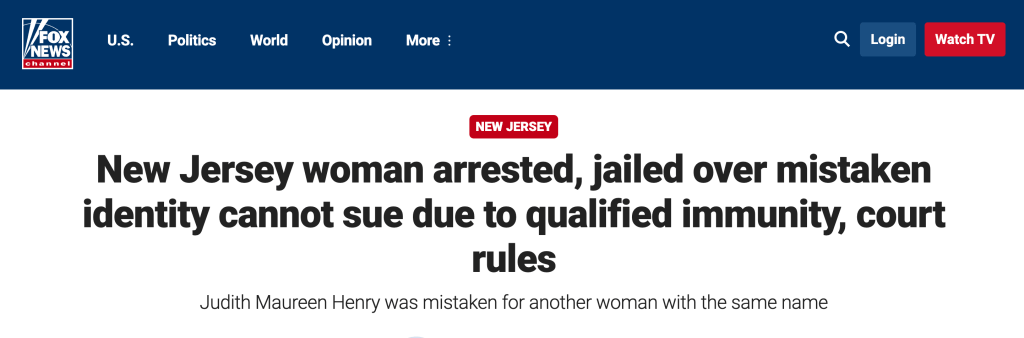
Here is a screenshot of the Fox News headline about this story, which pretty clearly implies that the whole case was thrown out by the judge over qualified immunity. It wasn’t. And it was not just Fox News, although Fox and the New York Post were the most egregious – and the most conservative. Regarding the text of the appeals court ruling – here it is, for reference: https://www2.ca3.uscourts.gov/opinarch/231987p.pdf. Legally, the key part of the ruling was “qualified immunity,” one of those concepts that are tagged as a “constitutional right” but actually was invented by the Supreme Court in 1967. It holds that law enforcement officers cannot be sued for doing their jobs. The Marshals who arrested and detained Ms. Henry had a legitimate and authorized warrant, including the wrong name, address, and picture. Since they were not the investigating officers in her case, they did not have an official obligation to do further detective work to confirm or deny the validity of the arrest. The judge notes that many defendants will claim to be innocent when they are not, and that it is not the job of the arresting Federal Marshals to ascertain whether those they arrest are lying.
Historically, this aspect of the law goes back to the post civil war reconstruction era of 1871 when white police officers would beat, lynch, and kill recently emancipated Blacks with impunity. (Mostly) Southern Whites could not stand to see former slaves being treated as humans, and the ranks of the police were not immune to these feelings. In response, Congress passed the Civil Rights Act of 1871, or 42 USC 1983. This law, for the first time, allowed private individuals to sue the police or other authorities if their constitutional rights were violated.

The Civil Rights Act of 1871 was known as the ‘Klu Klux Klan Act’ because the Klan was a primary target of the law, and included law enforcement officers. This law held firm until 1967, when it was essentially overturned by the Supreme Court. I guess the Justices thought it was now ok for the police to beat up Black people? I wasn’t there, so this is just speculation. The Supreme Court can be inscrutable at times. It was the height of the Black Panthers movement and, of course, hippies, electric guitars, the Beatles, and free love. Perhaps I will come back to this in a later post, but I was 17 and, well, I was 17. Let’s leave it there.
Qualified Immunity was the outcome of the decision in the Supreme Court case Bivens v Six Unknown Named Agents (1967). It held that law enforcement officers could only be subject to lawsuits if they violated certain specified constitutional rights of the plaintiffs, thus restricting the ability of private citizens to sue the police for false arrest, beatings, and whatnot. Federal Bureau of Narcotics agents raided Mr. Bivens’ home and arrested Mr. Bivens, even though they had no warrant authorizing the raid. Mr. Bivens sued, it was appealed to the Supreme Court, and this case let the Feds off the hook.
The Bivens ruling was clarified in Harlow v. Fitzgerald (1982), because the original ruling required that the state of mind of the police officer be considered, which was generally difficult to ascertain. Harlow ruled that the official would be liable in a civil suit only if a “reasonable person” in the same position would have known that the actions were not in accordance with the law. The judge in the Essex County case did not buy that the six Marshals acted outside the law, or that any other Marshals would have done anything differently.
The judge also dismissed Ms. Henry’s claim that, in effect, had she been white (or white and wealthy), the officers would have taken her plea of innocence more seriously, quickly checked her prints, and let her go right away. The judge ruled that Ms. Henry provided no evidence that racial bias was a factor in the 2 week delay.
How would anyone in these circumstances provide evidence of racial bias? Judith Henry could be right, but the judge is, in my opinion, asking for an impossible standard. Just because the Marshals didn’t say in their legal brief that “You were a Black woman, so we assumed that you were guilty,” doesn’t mean that it didn’t happen. No one in their position would ever admit to this. (Although in their defense, the Klu Klux Klax was pretty upfront about their goals and beliefs.)

The NJ Essex County Jail, where Ms. Henry was held for two weeks because the officers would not bother to do a quick check of her fingerprints (I took this photo from the New York Post) This story hits a personal note for me, because I became friends with an older man who spent 20 years as a guard at this very same Essex County jail. He recently passed away – he was in his 90s and life caught up with him. He had a senior position at the jail, responsible for training the newer guards. I asked him one day about the guilt or innocence of the prisoners at Essex County, and his reply (I am quoting him on this) was: “If the police arrest them, then they are guilty.” He was quite clear on this point, and probably represented the majority view of Essex County jail guards at the time he worked there.
This is, of course, not the view of our Constitution.
Obviously, my friend was not involved in the Judith Henry situation. But it sets a context for the facility she was held in, where no one would bother to take the one or two minutes required to check out her claim that they had arrested the wrong person. Stay tuned for further updates on this case.
-
This story began with what looked like yet another routine data breach, but became a lot more as I understood it better. Let’s start at the beginning.
My news feed last week included a story with this teaser: “The Social Security numbers and related data of 3 billion Americans was just stolen. Here’s what you need to know.”
What I needed to know was what drug those news editors were on, because I wanted some. There are only about 340 million people in the United States, not all of whom even have social security numbers. Here is a handy chart to illustrate the problem:

I love charts! You can see from this that there is something horribly wrong with the news. To find out what it might be, I went to Ground.News, a news aggregator that shows a neat list of each media organization that is running a particular story along with its evaluation of whether that organization is biased to the left, to the right, or is centrist. All of the 30 or so sources for this item were centrist (so far, good!) so I started scrolling through them. What I discovered was that there were 30 or so copies of the exact same text that had been reprinted by news outlets from all over the country. Ground.news’s AI bot had accurately summarized all of these stories, but unfortunately, they were all identical and therefore all equally preposterous.
Being the good citizen that I am, I sent a feedback note to the editors of Ground.News and received the most lovely letter in return. It said, in part: “Thank you for taking the time to report the error in the Ground Summary. We wanted to let you know that our team has seen your report and manually updated the summary with the correct information thanks to your help.” I will always treasure this letter, and I hope that it was written by a real person. After a few days, the news shifted to saying that the 3 billion was not the number of Americans, but rather the number of data records. I am going to take partial credit for making the world a more numerically literate place.
Let’s take a minor side trip and talk about why 30 news outlets would all repeat the same preposterously wrong information. Did someone substitute decaf coffee in the Starbucks daily orders for all of these people? Were they all at a convention of news editors, leaving the actual editing to their 10-year old kids? (I asked my 10-year old grandson to estimate the total number of Americans, and he was way off, despite being very smart, so I think that appointing our kids to edit the news would have some problems.) Were the news editors of all these publications going through emotionally messy divorces? I don’t think that we will ever know. Whatever it was, no one competent to edit the news was at the helm.
Going back to the story, the data breach was reported to come from a Ft Lauderdale company called “National Public Data,” or NPD. Here they are, as pictured on their own web site:

I wish I worked there! These people are loving their jobs. In the “About Us” section, it said that “Many different business use our services to obtain criminal records ….”
What? After reading this I am starting to be not so enthusiastic about working there- do they really help their clients to become criminals?
Of course not. I was joking. Actually, they are a data aggregator, aka data broker, or a company that collects massive amounts of private information about people and then sells it to anyone who pays them a very small fee, thereby rendering it not private anymore, and without the permission of the person whose information it is. I know that this sounds pretty unethical, but it is actually perfectly legal here in America! Who says America needs to be made Great Again? Only a country that is already great would allow this type of marketplace to thrive.
Being curious about why this job of un-privatizing our personal information would be so fun, I did a reverse image lookup on the four employees that are featured above on their web site, and discovered that the four happy young business people are actually an Adobe stock image titled “Group of Happy Young Business People”, who are models and have no connection with NPD. In other words, while NPD is happy to reveal your private information to anyone in the world, they are not revealing who they really are on their own web site.
NPD’s web site says that they specialize in background searches on individuals and on criminal records check. I quote them here: “All of our searches can be delivered in XML for you to embed into your applications or websites, which is perfect for those reselling public records.” This means that whatever information they might have is sold to people who then resell it. If your name pops up, there will not be any way to authenticate where the info came from, how trustworthy it is, or have any direct way to fix errors. What could possibly go wrong? (I apologize for not explaining XML; you will have to ask me about it outside of ‘Grandpa Blogs the News’. Sufficient to just say that it soups up the reselling.)
I tried to find out just how great the market for this stuff really is, and while I could not find a single authoritative source, there are multiple estimates that data brokers do more than $200 billion in sales annually, with likely growth to $500 billion in the next few years. To me, that is a lot of money, not to mention a lot of selling of people’s private information without their permission. Here is what EPIC, the non-profit Electronic Privacy Information Center, says about them: “As the data broker industry proliferates, companies have enormous financial incentives to collect consumers’ personal data, while data brokers have little financial incentive to protect consumer data.” They go on to clarify that we (Americans, that is) are the product and not the customers of this industry, giving us little recourse.

John Oliver did a segment on data brokers in April 2022. I know he is not to everyone’s taste, so please don’t watch if you are not a fan of his show. My feelings won’t be hurt. I am throwing this in as a bonus for Gen-X-ers or those who think like youngsters; you don’t have to watch to get the point of this blog entry. https://www.youtube.com/watch?v=wqn3gR1WTcA To bring us all up to date on the data breach, in April of this year, or about four months ago, a cybercriminal who calls himself “USDoD” claimed to have stolen the 3 billion social security numbers and related detailed information from NPD. In August, NPD admitted that this really happened, stating that it had “detected an intrusion” into its computers as early as December 2023. USDoD has evidently packaged this information and had started selling it on the “dark web.” (It is better left unsaid what the ‘dark web’ is, so I am not saying it.) USDoD was asking $3.5 million for the files. (This is about a tenth of a cent per data record – a relative bargain.)
The breach became more widely known when a second cybercriminal (I don’t know who this was or where he got the files from) made the same information available to anyone who knew where to look, but this time for free. Meanwhile, the expected legal dogpile has started. At least 14 complaints have been filed against NPD’s parent company Jerico Pictures Inc. and its owner Salvatore Verini, including a class-action lawsuit in Federal district court in Florida. It was the lawsuits that seem to have triggered most of the mainstream news about the event.
As far as I can tell, the lawsuits are alleging that NPD failed to adequately protect against unauthorized release of the private information. I am eager to find out what a Federal judge will make of this, since NPD is basically in the perfectly legal business of releasing unauthorized private information to anyone who is willing to pay a few cents per data record.
Let’s find out what we are talking about. It turns out that anyone (including you, the reader!) can query this stolen database to see what information it might have about you. If you go to ‘npd.pentester.com/breach’ you can enter a name, state of residence, and birth year, and get a listing of all entries that match those criteria. You don’t get all the data in the file because the people who run Pentester are just trying to let people know whether their info was stolen or not. To get a complete data set, you need to go directly to NPD and contract with them for a search. I have not tried this myself, but I think that anyone could do it (although they might be shutting down soon due to the bad publicity, the lawsuits, and all, so act quickly – this offer may expire soon).
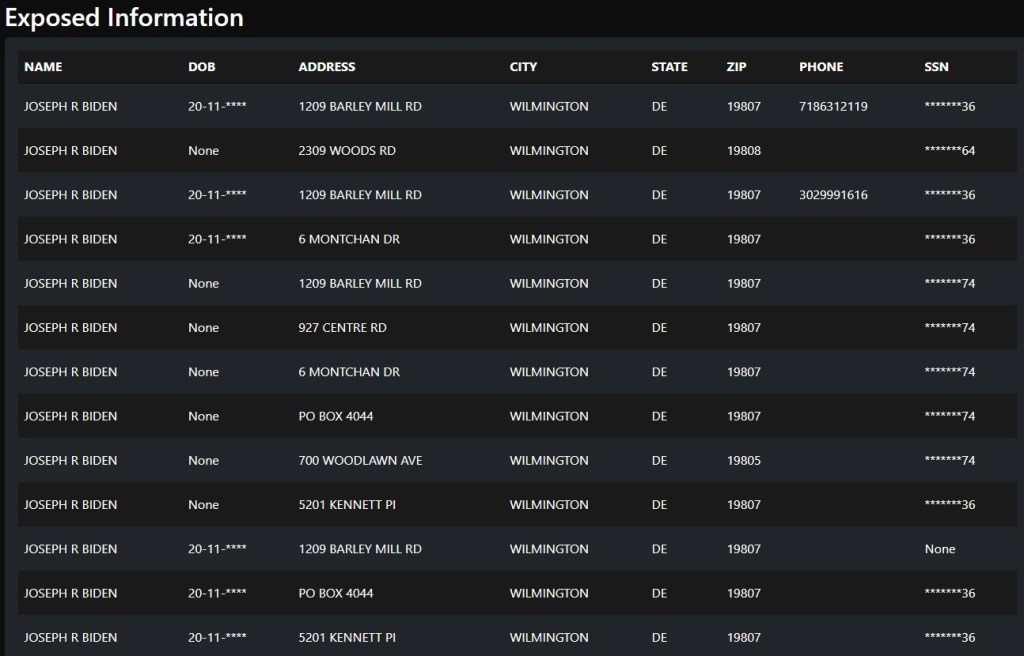
I did a search on Joseph Biden, Delaware, DOB 1942. This gives you a feel for what you get from Pentester.com, although the real stolen data contains much more. I figured that Biden’s information is already public, so no beans are being spilled. Public info says that the Barley Mill Rd address is where he currently resides; his birthday is November 20, so these elements seem to be correct. His dad was also named Joe, so some of these could be his father. I found 17 entries that had my personal information, including date of birth, my address, my social security number, my phone number, and whatever else what not shown by Pentester. Most of these had at least one item missing, and most were old. For example, there were entries for ’34’ instead of ‘134’ for my street address; this changed within a year or two of my moving into the house. Also, there were entries for my former home in Summit, NJ which I moved away from in 1969. A couple of them showed everything correct except for Tinton Falls, NJ, which I have never lived in. Some of them were blank in the Social Security number field, but not all, and the ones with an SSN looked correct. Ditto for my date of birth. The ones that had a phone number were all for my landline which is still active but unused, and which receives several spam calls every day. Maybe this is why.
When I put in Connecticut for the state, there was an entry for the address that my daughter lived in when she was in graduate school. This is because I co-signed a car loan while she was there. When I then changed the state to Florida, two entries came back with my mom’s address because I was listed for a time as a co-principal on one of my Mom’s credit cards. This was to help her purchase things after her eyesight started failing and ordering on the Internet was difficult for her.
This was getting to be fun, so I put in my Dad’s name and NJ. He died in 1996. Up popped 5 entries! These were all accurate, reflecting his addresses after about 1950. The addresses looked correct, although the dates of birth were wrong. I didn’t double check the social security numbers.
At this point you are probably asking yourself: “Why do I think that I have been hacked, sort of?” It is because the private information that is now available for free to criminals to use was already available to them, but just in a slightly different form, and from a perfectly legal company that would have been happy to sell it to anyone for a very small price per item.
Looking at what information was in this breach, it became evident to me that the data likely originated from one of the credit reporting agencies (“CRAs”). The three big ones are Equifax, Experian, and TransUnion, but there are others. When I compared the information on my credit reports to that of the data breach, I saw that they were nearly an exact match. The same addresses and information that are maintained by the CRAs showed up in the NPD data set. Voila!
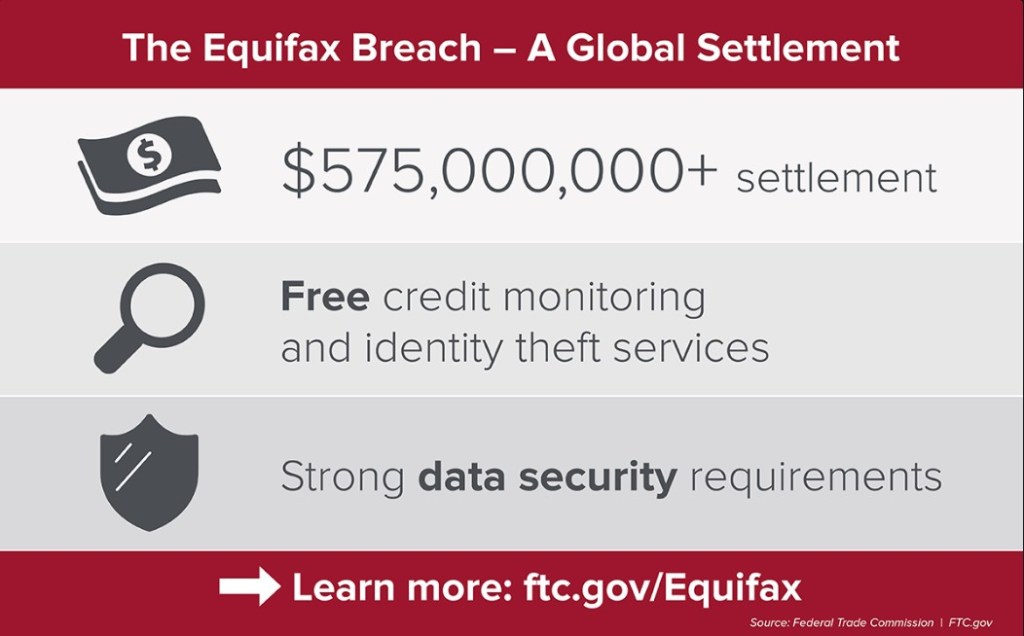
In 2017 Equifax, one of the ‘Big Three’ US Credit Reporting Agencies, lost control of 147,000,000 personal records of Americans including sufficient information that would allow criminals to steal from you. They were found by the courts to have not taken data security practices seriously. What are these CRAs? As a reminder, the CRAs provide a service to banks and other lending organizations that streamlines the time needed by a bank to decide whether you are eligible to receive a loan or not. Without these CRAs, the loan officer would have to undertake lengthy research to find out whether you paid all your bills on time, had an excessive debt balance, and so forth, and this information is distributed across many, many financial entities. The CRAs have an agreement with pretty much all banks whereby the bank tells the CRAs about every financial transaction you incur, including account balances and debts owed, and in return, the CRAs sell this information back to the bank when it wants to decide on loan eligibility. Believe it or not, you and I have already agreed to this “un-privatization process” as part of the fine print we sign when we open any bank account. Other organizations can use this service, like car dealers when they want to issue a car loan, and the CRAs also sell your financial information to businesses for other applications.
There is no way to opt out of this arrangement unless you don’t want to ever have a bank account. Being un-banked would prevent most Americans from holding a job, buying goods and services, renting or owning a home or apartment, owning a car, and so on. So, un-privatization starts with CRAs, and then gets amplified by data aggregators. When any of these has a data breach, the un-privatization gets worse, but this data breach appears to rest on a foundation of CRAs sitting on private information for virtually every American.
Arrgghhhh!!! Sorry this blog has turned dark! I wish I didn’t know any of this! You probably are too! Here’s what you can do:
- Contact the CRAs and ask them to freeze (not lock, freeze) your credit account;
- Tell your members of Congress that the US should have some sort of data privacy law, at least allowing you to opt out, and hopefully making the organizations more accountable for protecting your private information;
- Take out a cybercrime insurance policy, providing reimbursement and help in the event someone uses your information inappropriately;
- Pay closer attention to what sources of news you believe;
- Make sure your kids and grandkids know how many people live in America; and
- Go back to step 1. I don’t think that you have done it yet. I put it first for a reason.
And don’t panic! You are going to be ok.
-
Are you singing yet? Perhaps you are not old enough to recall when the four Lads from Liverpool released “Sergeant Pepper’s.” Here is a reminder: please listen before going on. https://tinyurl.com/3hmve3y8
Ready? I can wait for you if you want to slow down and listen before we go on (more on that later). Really, I’m not in a hurry. About anything.
John, Paul, George and Ringo were delightfully delusional about the pace of deterioration associated with aging. They were young – Paul wrote this song when he was just 16 – so I am going to forgive their ignorance on this topic.

L to R: Paul, Arthur Kelly, George, & John in 1958 when Paul would have written this song about getting old. George was the youngest, and the group had to lie about his age to allow him to play in bars. Arthur who? Today I read an article, a guest essay in the Washington Post, by geriatrician Dr. Rachael Bedad, regarding the characteristics of ‘frailty.’ Frailty refers medically to the steady slowing down of your body as you age, and the increasing vulnerability your body has to various stressors when you get older. Her essay was in part a response to the recent Presidential debate where President Biden appeared to be frail relative to his opponent, who was also about the same age but did not demonstrate the appearance of frailty on television. I quote from Dr. Bedad’s essay:
“Getting older often means accumulated wisdom, experience and even happiness, but it also means slowing down. Ours is a culture that greatly undervalues the potential contributions of older people who have so much to offer in terms of care, mentorship and experience and instead consistently portrays them as burdensome. To recognize that people are frail is not to think of them as no longer productive, dignified or wholly intact. It does not mean they are necessarily significantly cognitive impaired, nor does it mean they are imminently dying.
Elders who live successfully with frailty have transitioned into a phase of life in which they no longer expect and should not be expected to function in the exact same ways they’ve always functioned. It may mean changing one’s habits and routines to accommodate a slower-paced, less volatile life, accepting with grace both the privileges and the constraints of age.”
So, this has left me thinking hard about the question of how to best deal with becoming older than I was when I was younger. With any luck this will happen to all of us, and it will be helpful to have a way to accept whatever limitations come our way while enjoying life as actually experienced.
I have come to the conclusion that Frank Sinatra has already solved this problem by recording and making available to us his rendition of “That’s Life.” First, here is a YouTube video of one of his performances of this song. Please stop and listen, and then I will comment on why it’s relevant. There will be a quiz, so if you just skip over the video you will most likely flunk the quiz.
From a 1966 Television Special “A Man and His Dream Part II”, with Nelson Riddle conducting the orchestra. The TV special also featured his daughter Nancy whose boots were made for walkin’, although not in this clip. First, listen for the all-white Hammond B3 organ (you can see it in the back, near the end of the video) with a Leslie rotating speaker cabinet. My wife had one of these (although with a standard Leslie cabinet and a maple wood finish) which she enjoyed playing. Hearing it makes me happy.
Where was I? I think my mind was wandering just then, which I don’t recall happening when I was young. Oh, yes: “That’s Life.” This should be Joe Biden’s anthem, reminding him that he has been up and down, over and out, and he knows one thing; each time he finds himself, flat on his face, he picks himself up and gets back in the race. That’s life. He’s been ridin’ high in April, shot down in May. That’s life, and as funny as it seems, some people get their kicks stompin’ on a dream. If he didn’t think it worth a try, he’d jump on a big bird and then he’d fly.
Did you hear the music as you read through the lyrics above? Then you passed the quiz.
Whatever happens with Joe Biden and the office of the President, I think that I am well served to attend to Dr. Bedad’s words. Being older “… may mean changing one’s habits and routines to accommodate a slower-paced, less volatile life, accepting with grace both the privileges and the constraints of age.” That’s life.
-
In the news today the governor of Louisiana, Jeff Landry, just signed a law (H.B. 71) requiring that every public school in the state display a copy of the Ten Commandments. The display must be at least 11 x 14 inches; the new law allows for the display to optionally be paid for via donations so that the law is not an unfunded mandate. Legislators included a carve-out in the bill for private (i.e., Christian) schools, which are not required to post the Bible passage in their classrooms because, I don’t know, perhaps they didn’t want to be told what religion to practice. The specific wording of the commandments is spelled out in H.B. 71, and has to be exactly as follows:
“I am the Lord thy God.
Thou shalt have no other gods before me.
Thou shalt not make to thyself any graven images.
Thou shalt not take the Name of the Lord thy God in vain.
Remember the Sabbath day, and keep it holy.
Honor thy father and mother, that thy days may be long upon the land which the Lord thy God giveth thee.
Thou shalt not kill.
Thou shalt not commit adultery.
Thou shalt not steal.
Thou shalt not bear false witness against thy neighbor.
Thou shalt not covet thy neighbor’s house.
Thou shalt not covet thy neighbor’s wife, nor his manservant, nor his maidservant, nor his cattle, nor anything that is thy neighbor’s.”
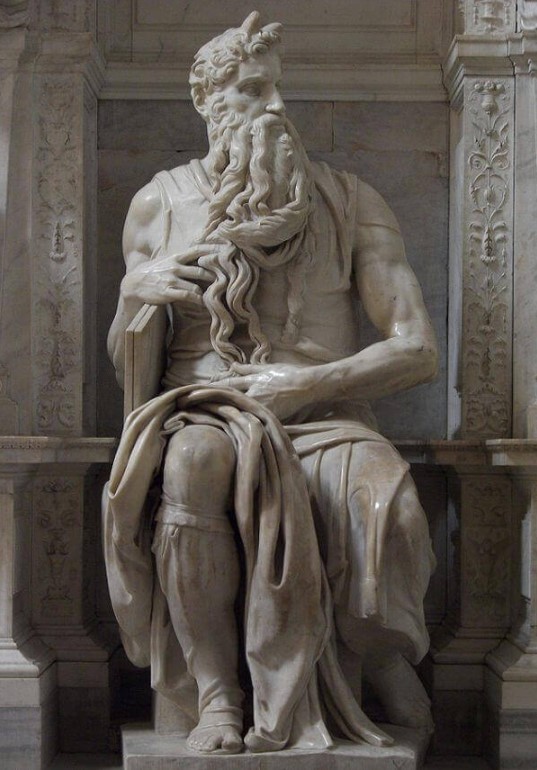
Michelangelo’s statue of Moses holding the 10 Commandments tablets (presumably 5 each), part of the massive tomb of Pope Julius II Notice that there are actually 12 commandments listed as required by H.B.71. There would be even more if you made the elements of the lists into their own declarations. The King James Version of the Bible in Exodus 20 lists 16 declarative statements, including a little bit more context for a few of them, such as a prescription on doing any work on the Sabbath, the addition of a few more farm animals, additional references to servants (which, like the man- and maid-servants were likely slaves when this was written) and so forth. You are probably asking yourself at this point why the legislators of the State of Louisiana thought that their citizens still owned slaves. It’s a good question.
One more note about the King James version; it is a translation that is in the public domain and therefore you don’t have to pay royalties to a publisher for each copy. This would have added up when you consider that the posters are required in every single classroom of every single public school – up through college – in Louisiana. It is a translation that is less authentic to the original Hebrew text than most others, but evidently this aspect is secondary to the authors of H.B. 71.
There are three different places in the Christian Bible where the commandments are expounded: Exodus 20, Exodus 34, and Deuteronomy 5. Each is unique, although there is some overlap regarding adultery, killing, stealing, bearing false witness, and holding the Lord as the one true God. (Exodus 34 seems to be the outlier, mostly dealing with rules regarding ritual Jewish animal sacrifice.)
The Ten Commandments as commonly understood here in the US are in two parts: part one concerns each person’s relationship to the Lord God, and part two concerns each person’s relationship to others. In our Western culture, the Commandments were among the very first statements defining the notion of the rule of law going back as far as 1500 BCE. They were a huge step forward from “the tribal chieftains decide what to punish,” where every tribe has their own rules based on preferences and whims of the elders.
Some of these commandments tell you not to do things that are already currently illegal, so perhaps these could have been omitted from the Louisiana law. For example, stealing: illegal. Killing: illegal under certain circumstances. Bearing false witness: illegal, when it leads to harm, although “little white lies” are fine, as are many other exaggerations or intentional misstatements.
On the other hand: adultery, not illegal, at least not in Louisiana. Graven or molten images: fine. Actually, not a thing. Swearing, if a reference to God is included: fine, normalized and encouraged. Coveting: fine, and it forms the basis for our modern American system of free enterprise and marketing. Dishonoring father or mother: not illegal, but discouraged. Working on the Sabbath day: What? Fine. Worshipping deity other than Judeo-Christian God: fine, for instance in New Orleans, the part of Louisiana where things like Voodoo and Santeria are accepted religious practices.
Does this mean that as Americans we have strayed from our ethical roots? It might. Or, it could just mean that our culture has evolved in the last 3,500 years to where our laws don’t have to be so blunt, don’t have include farm or pro-slavery references, and are now tailored to and better suited to what life is really like in Louisiana in the 21st century.
In the Biblical New Testament, Jesus is asked which of the commandments he considers to be most important. In Matthew 22, he strips the 10 down to just two:
“‘Love the Lord your God with all your heart and with all your soul and with all your mind.’ This is the first and greatest commandment. And the second is like it: ‘Love your neighbor as yourself.’ All the Law and the Prophets hang on these two commandments.”
If I were posting Biblical commandments on the walls of elementary schools, I would just boil it down to these two. I think they are clear, relevant, and actionable. And very religious.
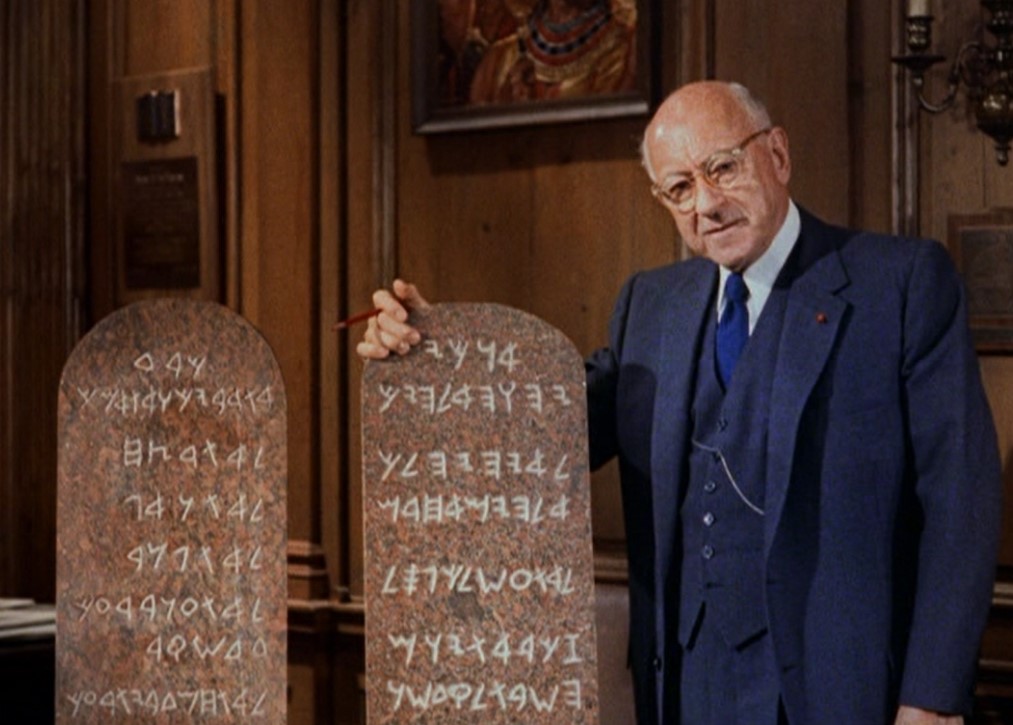
I could not find a photo of Moses, but I did find the next best thing: Cecil B. deMille, shown here holding the movie props for “The 10 Commandments,” the biggest, baddest and most extravagant movie ever made. This film gave the Commandments a huge boost when it came out in 1956, and started a long trend of movies that cost a lot of money to make. Don’t think too hard about what is actually inscribed on these tablets. The authors of the Louisiana bill claim that, while HB 71 is “slightly” religious in nature, it is primarily a historical document of great significance to the founding of the country. The law was amended to respond to some criticism that H.B. 71 was too overtly religious; it now includes references to other historic documents, such as the Northwest Ordinance of 1787, although none of these other ones are required to be displayed in every public school classroom.
So, like me, you are probably wondering: “What is this historic Northwest Ordinance of 1787?” The ordinance was drawn up to define the rights of the people and territories north and west of the Ohio River, which area is now Ohio, Indiana, Illinois, Michigan, Wisconsin, and Minnesota. Think Northwestern University. The ordinance included the right to representation, but only for non-enslaved and non-female residents. It included the freedom to practice the religion of your choice (which would seem to be antithetical to posting the Christian Ten Commandments in every public school classroom). It was enacted by the Congress of the Confederation of the United States, an entity that was dissolved and obsoleted just one year later in 1788 by the US Constitution. The Louisiana legislators are correct in identifying this as a document in the history of the US since it laid out the methods and procedures for territories not in the original 13 to become states. It did not make any reference to the Ten Commandments.
Where is this blog going? Feeling a bit lost, I am now going to take it back to the root of the separation of Church and State in America. And even before Thomas Jefferson, who famously used the “wall of separation” phrasing in his 1802 letter to the Danbury Connecticut Baptists. No, before this it was Roger Williams (1604-ish to 1683) who set the tone for religious freedom in the early colonies.
Williams was a Puritan, and came over from England to the Massachusetts Bay Colony in the 1600s, eventually to become a Puritan minister. The Puritans were strict about having a civil government that enforced what they felt were their Christian values and beliefs, effectively turning these beliefs into covenant laws. After experiencing disagreements with the colony elders regarding the entanglement of the State with the Puritan Christian church, Williams was banished in 1636 to what is now Providence, Rhode Island, and in the 1640s went back to England to obtain a Royal Charter for his new home, making Rhode Island a haven for religious freedom, a British Colony, and eventually a US State.

The “Hutch,” or Hutchinson River Parkway, named for Anne Hutchinson who was also banished from the Massachusetts Bay Colony along with Williams for holding views inconsistent with the theology of the Puritan Colony elders. She espoused “antinomianism.” I think having a Parkway named after me would be preferable to having Parkway bathroom stop named for me. Unlike Jefferson, Williams’ primary concern was not that the Church would corrupt the government, but that the government would corrupt the church. Williams thought that if church elders were given civil authority that it would lead to abuse of the type that had occurred in the Church of England (which he felt was beyond redemption), as well as in the European Catholic Church prior to the Protestant Reformation.
As a reminder, Protestants split from the Catholic church in large part because the Pope was taking payments for telling people that their sins were forgiven, or that their route to heaven was assured, or that they had paid their way to one form or another of saving grace. This was called “selling indulgences.” It was widely considered to be a corrupt practice, in that the Pope saw it primarily as a source of income for use in plundering the believers.
Although the Puritans are often thought to have come here to escape religious tyranny, in fact they set up a theocracy that was just as tyrannical in its own way as the Church of England, with no tolerance for dissent or acceptance of other religious beliefs, even (or especially) other Christian denominations.
Williams best documented this in a book published in England in 1644, “The Bloody Tenet of Persecution for Cause of Conscience.” He coins the phrase “wall of separation between Church and State,” and argues from the text of the Bible that the Church should not have civil governmental authority. He understood how easy it was for church elders to take advantage of the parishioners to the detriment of the spiritual mission of the Church.
Here is an additional note regarding the Puritans, who Williams felt invited corruption through entanglement. Puritans form the basis for the society depicted in Margaret Atwood’s “The Handmaid’s Tale,” which I have already commented on at some length. In that book, the founding fathers of a religious nation start off with the best of intentions, but inexorably are led down a path of theocracy, corruption, and harm to the citizens. The result is a religious dystopia where everyone is ultimately stripped of their freedom and free will, despite this not being the intent of those who set up the government.

In Margaret Atwood’s theocratic government, those who do not agree with and abide by the State’s religious tenets are killed or exiled. There is no freedom to express thoughts contrary to the tenets of the State (which are also the tenets of the religion). Coming back to Louisiana, the Governor and others who passed H.B. 71 requiring the entanglement of Church and State have the best of intentions for the people. After all, how can it be bad to expose children to the Ten Commandments? Are these commandments not the foundation for our Christian values and the rule of law?
Yes, in a way they are. But the concern is really that we would lose sight of the lessons learned from the Puritans, the Church of England, and the European Catholic Church of the middle ages. This particular Biblical display is a small step down the path of integrating the Government with the Church. Perhaps it would be fine. But, if Roger Williams were alive, he would be concerned that the religious leaders are losing control, and that they would ultimately be consumed by the power they could wield over the people. The result would be a Church that has lost its way in guiding souls to heaven, as well as a government that would not serve the democratic interests of its people.
-
For the past few years, I inexplicably perk up whenever tardigrades are the subject of a news story. Perhaps you will understand when you see what they look like:

Scanning electron micrograph of a tardigrade, with false color added for clarity. Tardigrades are typically about 1 mm long, or approximately the thickness of a credit card. (From the Science Photo Library) I know, you want to look away but you can’t. Here is a description of them, taken from an article last year written by Neal Patel of the Daily Beast:
“Tardigrades are some of the most compelling organisms to have ever evolved on Earth. Also known as water bears, these 1-millimeter long eight-legged creatures have been known to survive the vacuum of space, withstand boiling water for at least an hour, endure high amounts of radiation, and make it through unscathed from some of the most extreme colds imaginable. As a result, tardigrades have managed to find a home on nearly every place on the planet.”
Monday was “Earth Day” and the news that caught my attention was an article by NY Times science writer Carl Zimmer, who was also apparently fascinated by research about these cute little guys. He talked with Dr. Jean-Paul Concordet, a French researcher who recently co-authored a study about tardigrades’ ability to repair DNA after damage from ionizing radiation. Humans also have the ability to repair broken strands of our own DNA, but tardigrades manufacture the protein involved in the repair in prodigious amounts. Why do they do this? We don’t know. We do know that if we could replicate the tardigrade’s unusual ability to repair our own DNA, we could cure almost all disease. It would be a good thing.
Tardigrade’s mating behavior has also been studied. They are oviparous; that is, they lay eggs, like birds. Which they definitely aren’t. Boy and girl tardigrades need to mate for there to be babies, but the question posed by biologists in a paper published this past December was: How do the boys know which ones are the girls? They don’t have any sensory organs that anyone can find, nor are there any differences in how they look or behave. Challenge accepted by modern science! It turns out that they can smell the difference – even though they do not have noses. Justine Chartrain from University of Jyväskylä, Finland spent countless hours watching the tiny animals go after each other, setting things up so that it would be evident how they decided who was who. And it was the way they smelled. Those Scandinavians sure know a good time when they see it.

Chinese scientists are likely fans of the Incredible Hulk, whose transformation was triggered by a massive dose of gamma radiation. Here’s something you probably did not know: tardigrades are evolved from lobopodians. Lobopodians lived between 485 and 541 million years ago, aka the Cambrian Period. So, tardigrades have been on earth for around 500 million years, and have survived all five mass extinction events. I am not including a picture of any lobopodians because, frankly, they are ugly. Please don’t Google them.
According to Stephen Chen of the South China Morning Post in an article published in March 29, 2023, Chinese scientists have been inserting tardigrade DNA into human embryonic stem cells to see if they could create people who are resistant to radiation damage, just like the tardigrades. This would allow the Chinese army to be populated by “super soldiers” who are not susceptible to radiation from nuclear weapons. Chen says that they have achieved some success, at least at the level of human cells in a laboratory.
I think this was made into a movie – Jurassic Park? SpiderMan? The Hulk? I’m not sure which one, but I have only one question for those hard-working Chinese scientists: “What could possibly go wrong?”
Perhaps my favorite news story appeared in LiveScience in December, 2021 where a tardigrade was “quantum entangled” with a separate subatomic particle. Quantum entanglement was predicted by Niels Bohr in 1933 as part of the initial development of the theory of quantum physics. When two particles are entangled, a change to one will show up instantly as a comparable change to the other even though they are infinitely far apart in space. This means that the connection violates the cosmic law of the speed of light, or in other words, it violates Einstein’s theory of relativity. Einstein himself thought that quantum entanglement was impossible. Experiments since then have shown it to be a real thing, so I guess there is still a lot we don’t know about how the universe works.

Researcher Dr. Lee explaining the experiment. Note the stuffed plushy tardigrade glued to the whiteboard. Nice touch, Dr. Lee. Anyway, a group of eleven researchers headed by Dr. Kai Sheng Lee of Singapore took 3 tardigrades from a roof gutter of a university building in Denmark. (Tardigrades are common in moss and lichen, so gutters would be a happy place for them.) The scientists placed three of the little animals in the middle of a specially constructed electrical circuit and froze the assembly to less than one degree above absolute zero (or -459.67 deg F), with the tardigrades attached to one of two entangled subatomic particles. At this point, the tardigrades were technically dead. When one of the particles was “nudged” (vibrated?), the tardigrade and the other particle changed its resonant frequency, showing (in the words of the researchers) that the tardigrade was entangled. Then, after the tardigrades were slowly restored to room temperature one of them returned to life! (Oops- the other two died.)
I really have no idea what this means, other than these guys really had some fun with tardigrades in a very serious refrigerator.
Of course I had to see if I could find some tardigrades and examine them for myself. This part turned out to be a bigger and more frustrating project than I expected, and I have spent considerable hours this week scouring the area for moss and lichen, and then attempting to find a tardigrade in a microscope in my kitchen. Science experiments sometimes fail. I fired up the Internet and watched several videos explaining how easy it would be to gather them from your own backyard and see them in your kitchen.
The videos listed what equipment is needed: a microscope, petri dishes, a pocket knife, and bottled water. After ordering the petri dishes from Amazon and borrowing a microscope, I was set. Here is a picture of my lab:
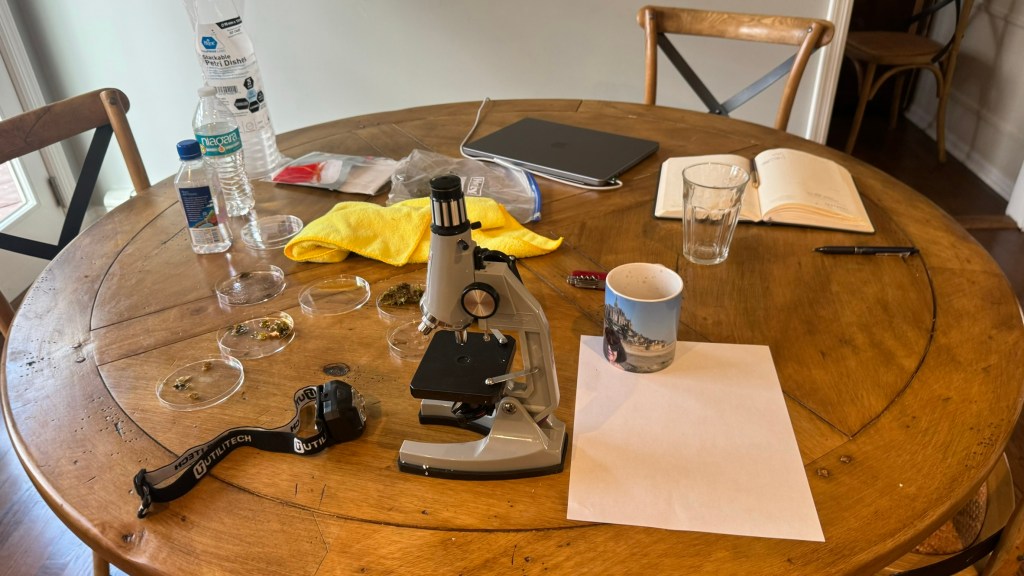
My kitchen laboratory. The instructional videos don’t mention coffee, but seriously, it was essential to this project. Next, I gathered moss and lichen from nearby trees. I did this every day for four days, each time from different trees, starting with the maple tree in my backyard, then a nearby creek, and eventually going to a local county park.
I’m not sure that you are allowed to remove moss and lichen from trees in a county park, but I did this at a quiet time and I’m pretty sure that no one saw me do it. Here is what one of the trees looked like, and you can see both the moss and some lichen:

I carefully removed a small sample of both moss and lichen, which tardigrades are commonly found in. Can you guess which county park this was? I hope not. I ordered the petri dishes on Sunday and they arrived Monday (and thank you very much Amazon Prime). You are supposed to soak the moss for between 4 and 12 hours (depending on which Internet video you believe), then squeeze the wet material into a sterile petri dish where you might find a tardigrade.
In my case, on Monday: Gathered moss and lichen from my yard, let them soak. No tardigrades.
On Tuesday: again, no tardigrades. Back outside to look for better trees, this time in a neighborhood creek.
On Wednesday: and again, no tardigrades. Back outside to look for different and yet better trees, this time in the county park. I was becoming discouraged. Did I mention that in science, experiments can fail?
On Thursday: I saw a tardigrade!
Unfortunately, I was not able to capture a photo of the one I saw. It kept moving around. Here is the best I could do to capture the sort of thing visible to me in the microscope:
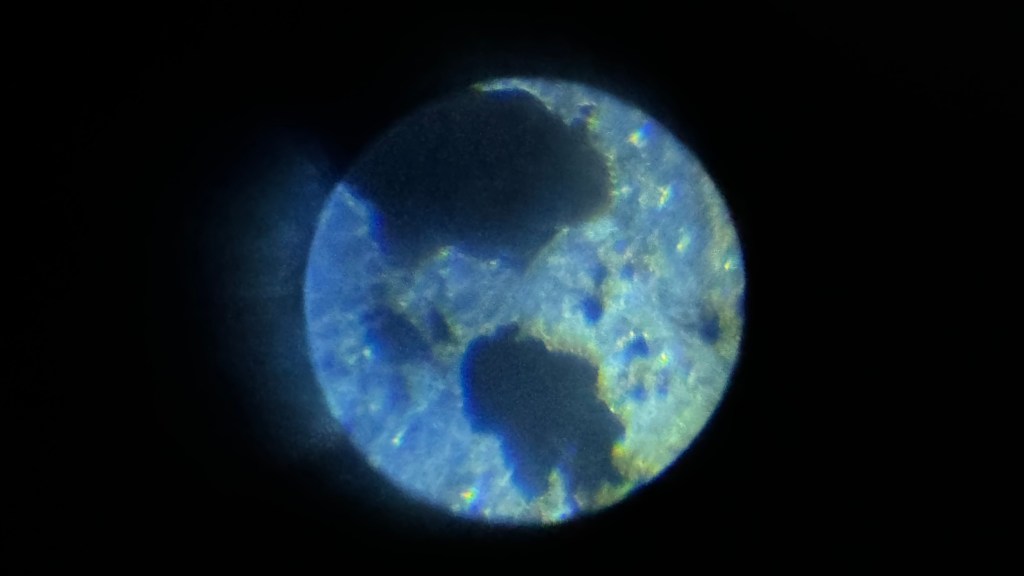
My view was not this blurry, but the 1990-era microscope was not designed to connect to an iPhone camera so this is the best I could do. I think the picture looks rather like a view of Australia from space, but you will have to use your own imagination.
Someday I hope to introduce my grandchildren to the fantastic microscopic world of tardigrades. They may hold to key to our species survival.
-
Subscribe
Subscribed
Already have a WordPress.com account? Log in now.
 Grandpa Dave Reads the News
Leave a comment