The second book in my ongoing quest to read the books most often banned from America’s impressionable youth was “It’s Perfectly Normal: Changing Bodies, Growing Up, Sex, and Sexual Health” by Robie Harris and illustrated by Michael Emberley.
This one is an introduction to how the reproductive parts of your body work, how you change through puberty, health consequences of sex, an overview of different gender-based relationships, including LGBTQ+ topics, and more, aimed at teens and those experiencing puberty. The pictures are drawings, and they are both cute and specific (and I thought, tasteful). I have chosen not to reproduce any of them here, for obvious reasons, but you get the idea. The illustrations needed to be specific, given that it is an educational volume for those who are encountering their own changing bodies for the first time.
I had no difficulty obtaining a copy from my local library.
I approve of this one, and when I was undergoing the mysterious changes of puberty, I would have very much appreciated the information. Otherwise, kids learn from the Internet. Which is bad.
Personal note: when I was experiencing puberty, my mom gave me a short pamphlet in lieu of talking to me about the subject. I was glad to have read the pamphlet, but this book would have been much better. At that age, you just want to know.
The number one banned book in the US today is Gender Queer, published in 2019. As a graphic novel it was a pretty fast read. I was able to easily get a copy from my local public library, so I guess that the whole banning thing is not totally working.
The story looks back at the maturing journey of the author, Maia Kobabe, born female, as he/she discovers at an early age that she feels like both a boy and a girl, and also neither.
In reading critics’ reviews of this story I learned that a novel of growing into adulthood is called a bildungsroman — my new favorite word — a German compound translated roughly as “novel of formation.” A classic example is Luke Skywalker, who discovers that the force was inside him all along.
Gender Queer deals frankly with issues of teenage sex and love, which is why some people don’t like it. I guess they can’t remember what it was like when they were a teenager, or they are now afraid of who they were.
Seriously, I am still a little bit afraid of who I was during my teenage years, and I’m now in my 70s. Growing up is hard work (like, does it ever end?), and the path from kid to adult is strewn with boulders and detours. This is true for those whose desires and habits meet the expectations of the culture they live in. For those who don’t feel like they fit, there be trauma.
Anyway, my take is that if you are one of those who experience ambiguity about your own gender, this book could validate your feelings and help you work through them. Good! Conversely, if you are more typically attracted towards the opposite sex, nothing about it would deter you from staying on the straight and narrow. Also good!
I personally think that pretty much everything is too dangerous for children, but somehow they have to grow into adults. It’s a miracle.
In reading the news on a daily basis, a recurring theme over the past couple of years has been the attempt to prevent school-aged children from reading books. According to PEN America, a literacy advocacy group, since the fall of 2021 almost 6,000 books have been banned in American schools. It’s an epidemic. In some schools in Florida, for example, the entire school library and all classrooms have had every book removed, with individual books reinstated only after a committee has read and reviewed each one for “suitability” and returned it. This process can take years, assuming that it ever puts most of them back.
This, of course, got me to thinking: if these books are so dangerous and powerful, then perhaps I should go take them out of the library and read them myself. And so was born a personal project.
In future blog posts, I will provide my book reviews of the ones that I read. I plan to select the ones most frequently banned, or that represent unique forms of evil should they seep into the impressionable minds our American future citizens. Or, maybe I’ll pick some that just sound fun to read.
This is the cover of the most challenged and banned book in America this year. It is a graphic novel, and is a bildungsroman of the author’s journey into adulthood.
I started with Gender Queer because there was a news story about the author, Maia Kobabe, attending a school board meeting where banning the book was on the agenda.
The American Library Association provides a map on their web site showing the most frequently challenged books in each state. New Jersey (where I live): Gender Queer. Texas and Florida (the states that win the contest of challenging the most books): The Bluest Eye. Ohio: It’s Perfectly Normal. I started with these, and also added two more to my list that have been challenged: The Handmaid’s Tale and Between the World and Me. More will be added as time goes on, I’m sure. These cover the most frequently banned topics of sex, race relations, and LGBTQ+ issues. (The LGBTQ+ ones are really about sex, so I guess Americans are focused on it.)
In Utah, the Bible was officially challenged. I have already read this one, so I am not going to go back to read it again as part of this project. I can understand why it might be banned; there are all sorts of corrupting ideas in it, like sex, murder, treachery, adultery, slavery, slaughtering women and children, and so on. Not to mention a future apocalypse that scares the pants off me, so I can’t imagine what a young mind would think of it.
To illustrate with a Bible story, Adam and Eve are the only people on earth, and they then have two sons. Then one of the sons has sex with his wife for the purpose of procreation; wouldn’t she have to have been his sister? Ewww. Feel free to come up with a better example if you don’t like that one, but it has the virtue of being right at the start of the whole book. Did I mention the part where they talk about Noah being drunk and naked in front of his kids?
Sorry, I was just kidding about thinking that the Bible should be banned, of course it should be part of American children’s literacy education! Although I wasn’t kidding about the challenge in Utah, which really did happen.
In any event, stay tuned for my next post where I will report back on reading a banned book. Wish me luck.
Very few who read this or thought about it believed its conclusion
30 years ago today in 1963, JFK was fatally shot in Dealey Plaza, Dallas, Texas. Within a few weeks, President Johnson signed executive order 11130 to create a Presidential Commission, popularly known as the “Warren Commission,” charged with investigating what happened, who did it, and why. They produced a report1 concluding that a single person, acting alone, committed the crime. By 1976 after people had a chance to read the and to digest the report, only 11% of Americans polled by Gallup believed this conclusion.
In 1978, Congress chartered another commission, the House Select Committee on Assassinations (HSCA)2, to further sift the evidence. The HSCA concluded that while Lee Harvey Oswald fired shots that struck the President, others were involved who fired shots from in front of the motorcade, that there was a conspiracy, but that evidence was not adequate to demonstrate who the other people or organizations were (although organized crime figures were suspected).
The whole thing is strange. The materials supporting the Warren conclusion were declared to be secret and to this day, 60 years later, have not been fully revealed to the public.
I have a personal interest in this controversy because in 1979 I worked with G. Robert Blakey, the chief Counsel to the HSCA. I was working on a project under contract with a Federal Agency to explore the feasibility of associative data queries, which was an early technical precursor to what we now know as Google search (although unrelated to Google). My project with him was not about the Kennedy assassination, but we discussed it during our down times. He thought the Chicago mob did it, and that they had set up Oswald as a patsy. The mob did not want Attorney General Bobby Kennedy to go after them.
The other primary theory is that CIA, with help from some members of the FBI, was behind it because they did not want Kennedy to curtail our involvement in the Vietnam war. Allen Dulles, a key member of the Commission, was the head of the CIA at the time, and had tight control over what evidence was considered by the Warren Commission. The CIA was uniquely in a position to hide evidence. I am partial to this explanation today, but you can pick your favorite. All any of us know for sure is that the Warren Commission conclusion is not credible.
Speaking of medical debt news, a class action lawsuit was just filed in Federal Court in Minnesota alleging that United Healthcare – my supplemental Medicare provider – used an AI algorithm, “nH Predict,” to reject claims under Medicare Advantage policies for post acute-care payments. The suit claims that the AI model is faulty 90% of the time, incorrectly denying care to the claimants and to others in the class.
To illustrate, a Medicare patient who is admitted to a hospital for a stroke for at least three days is entitled to up to 100 days of post-acute care in a rehab or skilled nursing facility. The length of stay within these guidelines is required to be determined by the patient’s physician. UnitedHealthcare is accused of cutting the rehab payments after, say an arbitrary 14 days per the nH Predict model, but falsely telling the patient that the discharge decision is due to Medicare rules. The company has set up targets for adherence to their AI model, and employees who deviate more than 1% from the model prediction are subject to being fired.
The suit further states that UnitedHealthcare knows that patients almost never dispute coverage decisions (they say disputes happen in only .02% of denials), and so the company simply pockets the premiums without paying for covered services. The company also saves money because use of the AI model eliminates the time and expense of individual review of coverage claims by medical professionals. How wonderful for them!
The actual text of the suit can be found here: https://tinyurl.com/bdhyhs4e. Please be aware that this case has not yet been adjudicated by the justice system, and therefore there is not yet a determination of guilt or innocence on the part of the defendant, United HealthCare Group, Inc. IMHO, there is no substitute for reading the actual text of the case, which I did. Note that many insurance claims under Medicare Advantage are paid promptly and in full; this suit only alleges a problem with a single provider where they are using a computer model in lieu of medical review of post-acute care needs.
From the so-called Joe Namath ad: “The Medicare Coverage Helpline is not affiliated with nor acting on behalf of any Government program or agency. The Medicare Coverage Helpline is a For-Profit Lead Generation campaign.” This text is included at the end, in very small print.
The case is interesting for a couple of reasons. First, if the allegations are true, then a great many Americans who have chosen a Medicare Advantage plan are at risk of financial harm should they need this type of expensive care. The two plaintiffs each paid on the order of $150,000 out of pocket for post-acute care services that they say should have been covered by their insurance policy. Most Americans can’t afford to do this; either they let the patient die, or they deplete all of their assets and declare bankruptcy. These are bad things.
The second thing that is interesting here is that AI is being given a bad name. There is nothing special about an “artificially intelligent” computer vs a “traditionally intelligent” one in this case; at its heart, someone wrote a program that takes millions of prior cases and develops averages for how much they cost, based on a complex series of parameters. Length of stay decisions are then based on these averages instead of upon the individual medical situations. The authors of the model will likely claim that these averages are very good ones, but it doesn’t really matter since Medicare does not allow insurers to discharge based solely on a computer model of past cases.
And finally, this is an important case because whether UnitedHealthCare Group wins or loses, it would impact millions of American seniors. More than half of Medicare enrollees are currently in an Advantage plan, amounting to around 30 million people. If the insurance company prevails, it will be a green light to use secret computer programs to deny coverage to those people who would otherwise qualify for services under the law. If the insurance company loses, then the world of Medicare Advantage will fundamentally change in a good way for patients. I will stay tuned.
In the obit section, we are celebrating the life of George “Funky” Brown, the drummer and one of the co-founders of Kool & the Gang, who just died in Los Angeles at age 74. He had been battling lung cancer. When asked to describe his music, he always replied, “the sound of happiness.” Here is a link to “Celebration” on Youtube, which he co-wrote: https://tinyurl.com/ycyuhvk6.
You can decide for yourself how happy it makes you. I have been playing it on a loop, and I am happy! It opens with “Funky” George on the drums – the backbeat is totally infectious. Plus, wait for the “jump, jump, jump” part, on the offbeat: it invites you to participate in the fun, like when watching the Wiggles. But you have my permission to do it as a grownup.
Feel free to check out Jungle Boogie, which he also co-wrote. The band members were from Jersey City and were largely self-taught. I’m for it. Are you happy yet? Sit-down dancing, anyone?
Because I am starting this blog, here is a piece I wrote on November 11th. Happy Veterans’ Day!
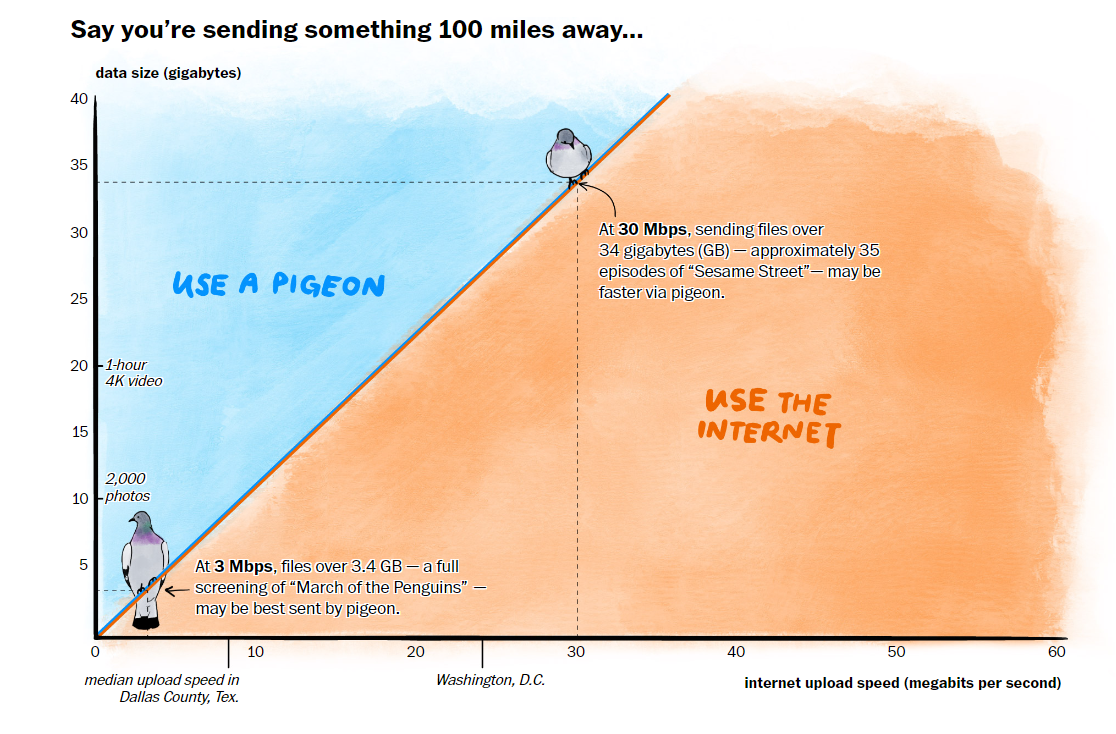
The Graphical Data Presentation Award O’ the Day goes to Janice Kai Chen, a journalist for the Washington Post who created this wonderful chart. It shows when the combination of broadband speed, distance, and data size would make it faster to use a carrier pigeon than it would be to use the Internet when sending vacation photos to your grandchildren:
You can’t make this stuff up. The conclusion here is that for relatively short, inter-city data transport (like the distance between New York and Philadelphia), put the data on a USB stick, tie it to a carrier pigeon, and let it go. And also important: keep a copy! Pigeons can get lost over Trenton! Ms. Chen is a graphic journalist for the Post; did you know there was such a thing? I didn’t. She has a Master’s degree in Geography, which seems to work well for this job.
And FYI, the state with the median download speed in the US is Indiana, at 29 Mbps, or “mega” bits per second (this is from FastMetrics), putting Indiana in the middle of the chart above. Delaware, at 59, wins while Alaska, at 9.94 Mbps, brings up the tail end. The economics seem to favor more densely populated areas where the provider can spread the investment in equipment over more customers. My computers benefit from a 1 Gbps connection (I live in a densely populated area, which is about 100 times faster than the median Alaska bandwidth.
On a personal note, my wife’s grandparents raised pigeons in Illinois, and I recently mailed a USB stick to a cousin in Hawaii with 8 gigabytes of vacation pictures (or 64 gigabits of Internet data) because his Internet connection is slower than mine, and he didn’t want to wait forever for the download. So I love this chart!
Grandpa Dave here, and I get up way too early in the morning, probably because I am old, and start my day with a pot of coffee and my trusty MacBook Pro which I unleash on the news o’ the day. (OK, it’s really things that happened yesterday that get published today.)
I have been occasionally writing my thoughts about selected news stories and created this blog because I thought there might be other people also interested in what I considered to be newsworthy. It’s not “all the news” and it often is not “fit to print,” but half of it is before I have had enough coffee so I make no promises.
FYI, I start with the Washington Post (for overall coverage of things American), then Google News (which I’m sure uses AI to guess only those stories that a robot thinks I would want to read), then the UK Guardian (to get a more objective view from across the pond), and then wherever things take me. I have browsed the Christian Science Monitor (fewer stories but nicely crafted), the New York Post (shared ownership with Fox News), Fox News (or sometimes OneAmericaNews, which is a bit more to the right), BoredPanda (please don’t ask), Al Jazeera (to stay balanced, it’s actually pretty good), the New York Times (I have a print subscription), and you get the idea.