Next in my series on books of the banned, “The Handmaid’s Tale” by Canadian author Margaret Atwood is many things at once. It has often been banned because sex (that is, forced conception and childbirth) is depicted, and is in fact an essential element of the plot. The American Library Association reported it to be 7th most commonly banned book in 2019, citing “vulgarity and sexual overtones” as the reasons for the challenges.
First, the plot: a right-wing religious organization, the Sons of Jacob, overthrows the Government of the United States by killing the President and all the members of Congress. The Constitution is suspended. The US is replaced by a set of smaller warring countries, all based on their own religious laws. The book takes place in the fictional Republic of Gilead, centered in the Boston area, where they institute a form of rule based somewhat on the American Puritans, where women have no rights (they are not allowed to own money or property), control is through the military, and if you disagree with their interpretation of the Old Testament you are killed or sent to death camps. Due to global pollution the birth rate has dropped, and so fertile women are enslaved as Handmaids who provide children to the military leaders. By having sex with them followed by forced childbirth. The protagonist, Offred, is one of these Handmaids; Offred provides a narrative fleshing out what life is like in Gilead. The word “handmaid” comes from the story of Rachel and her handmaid Bilhah in the Bible, Genesis 30. Look it up and shudder. The Handmaid’s Tale is much more interesting and complex than this short summary, so I urge you to read it.
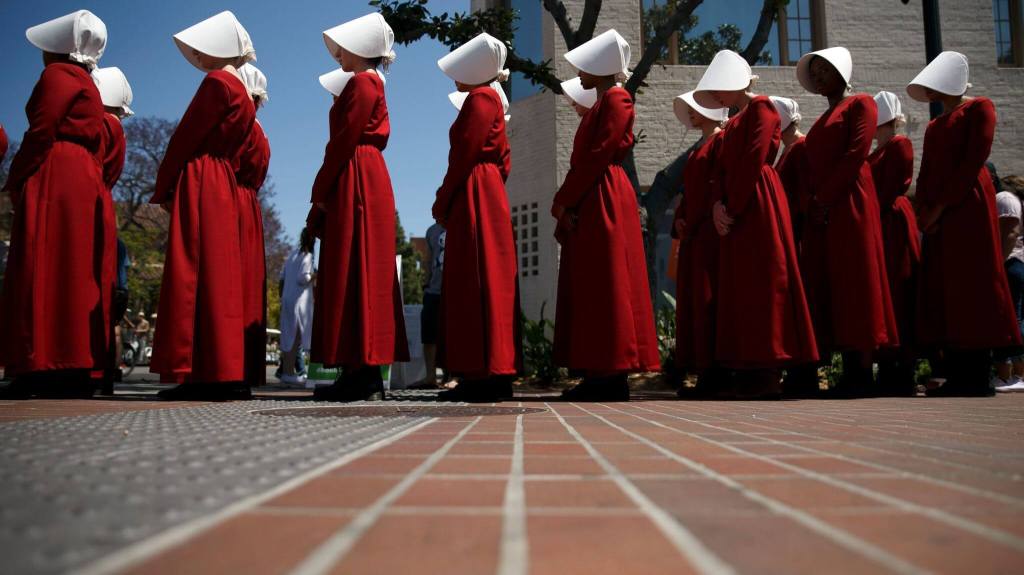
Margaret Atwood was influenced by the Iranian Imams and the government they set up. Iran is now governed by Islamic law, as interpreted by the religious leaders currently in power. She said that she wrote the book because people were telling her that “it couldn’t happen here” in America. This work was her way to show how it could. Although written in 1985, she thought that some of the trends under the Reagan presidency were leading us in a theocratic direction.
If anything, these trends have dramatically accelerated since then, although there has not (yet) been a successful violent “Christian” overthrow of the government. However, we have had a more subtle takeover of the institutions of the government resulting in laws that have moved us in that direction. Like, making abortion illegal in accordance with Christian beliefs, and thus imposing forced childbirth in many states; enabling state funding of religious schools; electing a House speaker who is clear and direct about his intention to pass laws that force fundamentalist Christian tenets on all Americans; and altering the composition of the Supreme Court so that Christian beliefs (of the Judges) become a criteria for case decisions.
I may need a few days to let the various messages in this one settle in. The author says that the book is not fundamentally about sex or mistreatment of women, but rather about power and its abuse. I agree.
As if to put a period on this sentence, recently the news included an article about the first time in the history of the country that a Catholic School is to be fully funded by the Government. Oklahoma passed a state law, about to be put into effect by the St. Isidore School, that allows public money to fully support a religious school. The school’s charter says that it will follow Federal laws only to the extent that Federal laws don’t violate Catholic religious teaching. And I did not make that last part up.
 Grandpa Dave Reads the News