I have read so many stories about Republicans thinking that Ayn Rand was their hero, I thought I should find out why. Rand wrote two novels explaining her philosophy, ‘The Fountainhead‘ and ‘Atlas Shrugged‘. For $11.49 you can buy a boxed set of both books in paperback from Amazon. Since the combined page total is 1,738, I chose to cheat and to watch the movie versions of them. So sue me.
In case you were wondering, she pronounced her first name to rhyme with “mine,” but I say go with your gut on how to say her name. I won’t judge you.

Rand was born Alisa Zinov’yevna Rosenbaum in St. Petersburg in 1905 into a well-to-do Jewish family. As part of the 1917 Russian revolution, the Bolsheviks “collectivized” (that is to say, stole on behalf of the State) her father’s pharmacy, plunging the family into poverty. They fled to Crimea, at the time an autonomous Soviet Republic. This naturally made a big impression on the young woman.
In 1926 she emigrated to America looking for a job in Hollywood, found it, but focused on her true passion: writing. She became a naturalized US Citizen in 1931. Starting as an extra for Cecil B. DeMille, she graduated to junior screenwriter, then began writing her own books. Her first successful novel, The Fountainhead, published in 1943 slowly gathered a following, both here and around the world. She followed it with the longer and more complex Atlas Shrugged, published in 1957.

The book is an allegory describing her philosophy that a government’s primary purpose should be to allow and encourage business owners to become as rich and successful as is humanly possible, without interference from the State. She contrasted this with Soviet-style collectivism, where the State controlled profits and output, and the purpose of the government was to make all businesses as equal to each other as was humanly possible. In the Soviet system, and in her novels, the State controlled all business profit, redistributing it from the successful to the unsuccessful with the result that there was no incentive by the owners to create a successful or profitable company. She would say “from the makers to the takers.” Consequently everyone lived in poverty.
As a side note, George Orwell wrote his allegorical novel Animal Farm at about the same time, portraying post-revolution Stalinist Russia as a farm where the animals have staged a revolution against the humans, and then claim to be running the farm in a way where all animals are equal. Some animals, of course, turn out to be more equal than others. Orwell despised Stalin.
In the 1970s in the US, Rand’s statement of purpose for government policy was a welcome bookend to Milton Friedman‘s Chicago School of Economics, which argued that the economic purpose of a business was also to put as much of the profits into the pockets of the owners as was humanly possible. Economists called this “maximizing shareholder value,” and it was hugely popular with the business owners, for obvious reasons.
Friedman taught American business leaders that sharing the profits with customers, suppliers, and employees was counterproductive to the country’s interests, and would lead to ruin. He won a Nobel Prize for this! I’m not making this up. President Ronald Reagan, along with Rand devotee and Chair of the Federal Reserve Alan Greenspan, endorsed both the “Randian” approach and the “shareholder value” approach with wild enthusiasm. Greenspan was in Rand’s inner circle, helping her to edit and refine her novels. I have already touched on the topic of shareholder value in my essay about share buybacks: https://grandpadave.blog/lets-talk-about-share-buybacks/.
Let’s talk about the two novels, then.
The Fountainhead, published in 1943, is about Howard Roark. Roark is played by Gary Cooper in the film version, an architect who refuses to compromise in any way on his architectural ideas. Cooper falls in love with Patricia Neal, a free-thinking architecture critic, who ends up marrying Raymond Massey, the owner of a NY Post-type newspaper where she worked. Cooper and Neal are in love with each other throughout this, and naturally tension flares when Massey directs his paper to smear Cooper (aka Roark).
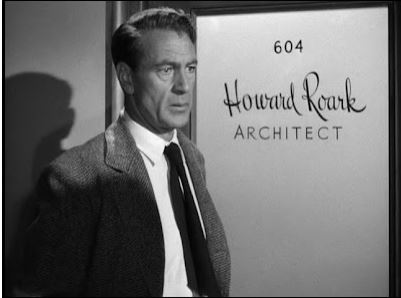
According to the narrative of this novel, collectivism is allegorically depicted as a business culture where everyone has to conform to the same ideas, there is no room for individual ideas or innovation, and the business culture enforces the conformity. This is illustrated via the world of architecture. Roark designs buildings that he likes and thinks are interesting but are different from what is accepted by the culture. (In the movie, his buildings seem to be an homage to Le Corbusier and/or Frank Lloyd Wright.) He gets blacklisted, eventually having to take up a job as a common laborer drilling rocks in a quarry. No one wants to hire him to design buildings, as they all believe that anything new or unusual (read: unequal) is bad. A rich, eccentric client finally hires him for a small project. Roark thus gets back in the architecture business without compromising his “principles,” but works only on smaller structures.
Since he is not being hired to design significant structures but still yearns to, he secretly designs an innovative housing complex under an agreement with an architect friend whereby the other guy gets all the credit and the money, as long as there are no changes to Roark’s design. When the partner agrees to changes, Roark dynamites the buildings. He would rather see his work destroyed than compromised. He is arrested, and acquitted by a jury who apparently agree that stifling his ideas is akin to an attack on his inalienable right to create and innovate. His speech defending himself in court is apparently famous, and I have included it here:
Ayn Rand considered Roark to be the “ideal man.”
Continuing on was her second book, Atlas Shrugged, published in 1957. Because it was a much longer book, it was filmed as three separate movies with different actors playing the key roles in each.
Atlas depicts the world of two main characters, Dagny Taggart and Hank Reardon. Taggart is the C.O.O. of the Taggart Lines railroad, the biggest and most successful in the country (thanks to Dagny’s independence from the crowd), while Reardon owns a steel manufacturing company that makes metal 10 times stronger than standard steel and weighs half as much, which Reardon invented. The country is in a depression, brought on by collectivist policies of the government that punish companies like Reardon’s for having a better product. Gas costs $40/gallon, so rail is the dominant form of transportation. I’m sure that this seemed more plausible in the 1950s when the book was written than it did in 2014 when the third movie came out.
Meanwhile, all the individuals who are smart, creative, and stand out from the crowd start mysteriously disappearing. This plunges the country into an even worse depression. With no leaders, most of the companies essential to the functioning of the US economy go bankrupt or don’t produce enough, because businesses no longer have any incentive to do better.
Eventually you learn that the innovators and leaders have all gone on strike. A guy named John Galt, who apparently invented a machine that generates energy with no fuel (think perpetual motion), realized that under the collectivist FairShare law he could not benefit from his invention. So he organized a hidden commune in Colorado where the true thinkers could be together on strike until things changed, and do what they wanted in the meantime. “Who is John Galt?” becomes an unanswerable question for those not included. Don’t think too hard about how effective a strike would be if no one knew you were doing it.
The story ends with the total collapse of the American government and the economy. Galt is physically tortured by Dagny Taggart’s brother Jim and his fellow collaborators from the collectivist Government; finally, Galt is rescued in the nick of time by Dagny. Why the torture? Very unclear. The movie ends here, with the innovators free but the country experiencing catastrophe.
In the novel, leaders decide that they can come back, take charge, and restore a free market economy. It is a choose your own adventure. The movie was made in 2014, after Rand’s 1982 death, so they did not ask her.
The quick version of Rand’s message: it is better to blow up the entire economy than to forego your own ideas and go along with the collectivist crowd.
Throughout, forcing business to be altruistic is evil, while allowing them to do whatever they want, completely unfettered by any Government laws, taxes, or regulations, is good. Very good. If a man decides to be altruistic that is his right, but he should not be forced to by the government. There is no middle ground in the world of Ayn Rand.
There have been some reports of Donald Trump saying that Rand was one of his favorite authors. If he really said this, he did not repeat it over and over, which is unusual for him. I was able to find only one confirming report published in April 2016 in USA Today by journalist Kirstin Powers. She wrote what she said was the result of a one-hour interview with him in his Trump Tower office. Here is an excerpt from Powers’ article:
“Trump described himself as an Ayn Rand fan. He said of her novel The Fountainhead, “It relates to business (and) beauty (and) life and inner emotions. That book relates to … everything.” He identified with Howard Roark, the novel’s idealistic protagonist who designs skyscrapers and rages against the establishment.”

As an aside from me, Ayn Rand was an ardent and very public atheist. She felt that adherence to religion led to a collectivist mentality, and so was disdainful of it. Since Trump had many supporters who were evangelical Christians, he might not have wanted to play up the whole Rand thing and risk alienating a key part of his voting base, perhaps explaining why he did not keep repeating his being a fan of Ayn Rand.
In any event, Donald Trump certainly rages against the establishment, like Howard Roark he loves his own skyscrapers, has repeatedly called for a smaller Federal Government, and wants to reduce taxes on the wealthy business owners. And consistent with Rand’s philosophy, threatening to blow things up that he disagrees with is a common tactic of his.
The climax of Atlas Shrugged is another trial scene, where Hank Reardon is accused (correctly) of violating the collectivist FairShare Act. It seems that he sold some of his factory’s product to a Mr. Danager, because Danager needs it for building up his coal mine. Reardon needs the coal for his steel furnaces. Taggart needs the steel to build out the railroad, facilitating commerce for Americans. It’s a virtuous Randian cycle! The problem is that the FairShare law prohibits selling any product to a single customer without selling the same amount to every other potential customer. (Remember “all animals are equal”?) The collectivist intent is to prevent any one person from getting a competitive advantage; everyone benefits equally from everything.
I will ask you to watch the clip before we go on:
Did you watch? Don’t try and fool me! I think that this is a clearer presentation Rand’s world view than the first trial speech. I only wish that Perry Mason had been on hand to do the cross.
As the Atlas story concludes, Hank Reardon believes that if he is punished for violation of the law, and for succeeding in business, many people – thousands – will get hurt when his business, and those it buys and sells from, collapses.
The parallels between Hank Reardon refusing to recognize the validity of the law as it applies to him and our current President writing executive orders as if the law does not apply to him jump out of the screen at me.
Reardon, although found guilty and sentenced, has his punishment voided by the judge. The judge thinks that special considerations around Reardon make it impossible for them to actually impose any punishment; the judges understand the economic catastrophe that enforcing the law entails.
I can’t help but notice that, like Reardon, our President was found guilty of criminal felonies for violating business law, but then had all punishment voided by the sentencing judge due to special considerations around his situation. These two situations are not directly comparable; but I would be surprised if our President does not see them as equivalent. This is the part of the Rand philosophy that makes it so attractive to its fans. (For an extra points study question, compare and contrast these two situations.)
Here is an excerpt from our President’s recent speech to the joint session of Congress: “For nearly 100 years the federal bureaucracy has grown until it has crushed our freedoms, ballooned our deficits, and held back America’s potential in every possible way. [….] My administration will reclaim power from this unaccountable bureaucracy, and we will restore true democracy to America again.”
And here is an excerpt from his Mar-A-Lago victory speech after his recent election, introducing Elon Musk: “He’s a special guy. He’s a super genius. We have to protect our geniuses. We don’t have that many of them. We have to protect our super geniuses.”
I think I hear the still, small voice of Ayn Rand in these words.
That’s it. If you want to really overdose on this topic and get a little creeped out at the same time by the way she moves her eyes, watch this 1959 Mike Wallace interview of Ayn Rand:
https://www.youtube.com/watch?v=lHl2PqwRcY0
Thinking about the Sean Hannity interview scene earlier, it is refreshing to observe and enjoy Mike Wallace’s respectful interview techniques.
 Grandpa Dave Reads the News