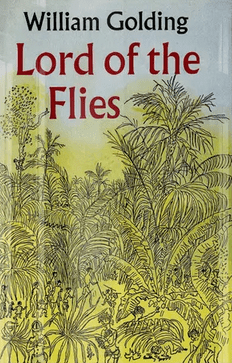
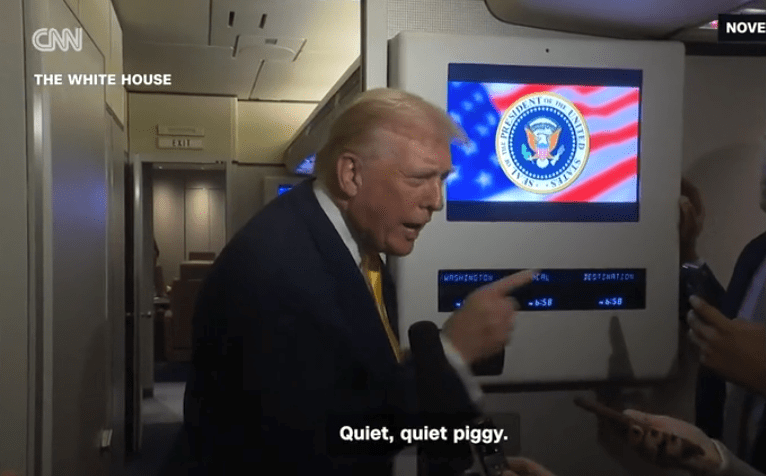
A topic I should bring up at my next therapy session is the relationship between our current situation and William Golding’s novel ‘Lord of the Flies’. A recent essay in HuffPost pointed out that “Quiet, Piggy!” is a line from that novel. Trump said this to a reporter on Air Force One who asked him a question about the Epstein files. I thought that he just meant this to be a generic insult to the female reporter, calling her a pig. There did not seem to be any context for the use of that particular phrase. Apparently, I missed the larger significance of these words.
In their reporting on the incident, the New York Times called it a ‘schoolyard epithet,’ so they had the same initial reaction that I did. Specifically, they thought was just a random phrase meant to demean and belittle the reporter while not answering the question. More or less channeling a middle school bully.
Here is how Trump’s press secretary summarized the incident in a press briefing shortly afterwards:
“The president is very frank and honest with everyone in this room. You’ve seen it yourself. You’ve all experienced it yourselves. And I think it’s one of the many reasons that the American people re-elected this president, because of his frankness. And he calls out fake news when he sees it. He gets frustrated with reporters when you lie about him, when you spread fake news about him and his administration.”
In the Lord of the Flies, a group of English schoolboys, perhaps 10-14 years old, is stranded on a small uninhabited tropical island. They had been evacuated from nuclear war-torn 1940’s England in a military plane that crashed. They quickly split into two groups: one, led by democratically elected Ralph, wants to think through the best way to survive, have fun, get rescued, and meanwhile live by rules that protect them all, while the other, led by Jack, reverts to tribal savagery. Jack’s group just want to hunt and kill. Piggy is the nerdy member of Ralph’s group who is socially unpopular but smart. Piggy’s spectacles are their only means to start a fire, key to any rescue and to survival. He represents the rational use of science and logic to enhance their chances. Jack’s tribe ultimately kills him for it.
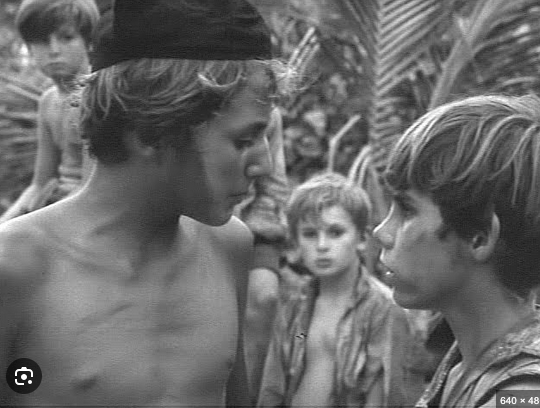
There are parallels in Jack’s leadership style to modern autocratic national leaders. Jack promotes the natural fear that the boys have of a mysterious but imaginary ‘beast’. He uses the ‘beast’ myth to rally his tribe against the other group, amplifying the boys’ fears and hatred instead of attempting to soothe them. Jack insists on absolute obedience to himself. This takes priority over any system of rules or laws; strict obedience to him is the only law, and he punishes and humiliates tribe members for disobedience to his whims. Violence is the glue that holds them together, both in the group’s actions outward and in how they treat each other. They paint their bodies in order to create a sense of in-group belonging, unlike the ‘others’ whose skin is now different. All but a couple of the boys join Jack’s tribe. This ultimately leads to killing two of the remaining members of Ralph’s group, including Piggy, with no sense of shame or regret by the aggressors. Piggy is killed by Jack loyalist Roger rolling a giant rock onto him, which also crushes the conch, the symbol of the rule of law and democratic leadership. Jack then yells “…There is no tribe for you anymore. The conch is gone – I am chief!”
The story ends with Jack starting the entire island forest on fire in an attempt to hunt down and kill Ralph, the last surviving non-savage. The fire attracts a British warship which sends a landing party to the beach, and the British officer is faced with the savage boys. Neither the officer nor the boys knows how to react, leaving the reader to decide what might happen next.
Here is an excerpt from a 2025 review by Charles Switzer: “In an age when young people face constant pressure to conform, perform, and pick sides — whether online or in real-world social hierarchies — the breakdown on Golding’s Island feels painfully familiar. The fear of being cast out, the seduction of belonging at any cost, the ease with which violence becomes a form of power — these aren’t relics of colonial history. They’re part of the emotional architecture that today’s young people still must navigate.”
And here is a forward to the book written by Stephen King: https://tinyurl.com/4jy6v8z6. He describes the resonance of this book better than I could.
Did our President know that “Quiet, Piggy” was a reference to this novel? Why else would he use this phrase? Let’s sit back and reflect on that for a bit.
Here’s the video of the interaction on Air Force One: https://tinyurl.com/jze5x3j2. The use of this specific phrase seems intentional. He says the words just the way that Jack would, with a sense of both command and derision, pointing his finder condescendingly at the reporter. “Join my tribe or die” seems to be oozing from his body language.
In response to the reporter’s questions, Trump denies any responsibility, and then starts rambling about the other people, mostly his political opponents, who he suggests were involved in illegal activities. Anything bad about Trump, he says in his response, was because Epstein was jealous of Trump becoming President.
Anyway, the question that continues to float in my brain is “Why did our President choose this particular wording?” Trump famously does not read books. Has there been a discussion at one of his staff meetings, or private dinners, of the parallels between his administration and this novel? I can’t imagine how this would occur.
I would love to have a conversation about this novel, especially with someone in the same age group as the characters depicted. I read this book in the eighth grade, and still recall my English teacher Mr. Moffat having us act out some of the scenes. It is hard to imagine what the teachers in the adjacent classrooms thought. I now have a much different understanding of the darkness of the themes and the potential for harm that giving in to them represents. By the way, Mr. Moffat once remarked in class that when he was in eighth grade he thought that being that 13 years old was wonderful, and life was great. In his 30s, he was so glad not to be 13 again, because of how quickly he felt this age group could turn to bullying and hurtfulness. I think this may have informed his lessons to us regarding the Lord of the Flies.
Did ‘the Donald’ read this book in eighth grade, as I did, but instead of fondly recalling his teacher, he remembers associating with the character of Jack? And in particular, Jack’s role in the novel as the one who leads the crash survivors into tribal savagery? And who, in pursuit of killing anyone who would not go along, burned down the forest that was providing them all with sustained life? I am pretty baffled that this would be the case, but I have not been able to come up with another, more plausible, explanation. Someone help me please.
 Grandpa Dave Reads the News