Today’s topic is a book review of something that caught my attention and has been nagging at me. The book is “Ultra Processed People: The Science Behind Food That Isn’t Food (2023),” by Chris van Tulleken. It is yet one more in the long sequence of books that I have read where the thesis is roughly: “OMG! Everything I believed about X is wrong!” In this case, the “X” is how people regulate their weight and what they eat. In other words, Ultra Processed Foods (UPFs).
I recommend that you do not read this book. If you ever want to be able to eat normally in America, STAY AWAY. In fact, maybe you should stop reading this blog right now. I wish I were kidding.
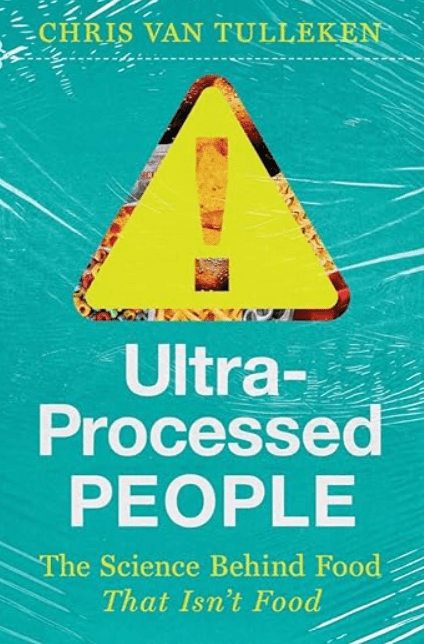
The author is a British nutrition and biology researcher whose work, and many others he cites, shows that the global obesity epidemic correlates most closely not with the ingredients of the food (like salt, sugar, proteins, carbohydrates, or fats) but with the extent of processing that industrial food manufacturers use to create the item. His research, and the extensive research of others that he cites, shows that the ingredients are not the cause of obesity, but rather the food manufacturing process is. And it’s not our fault.
This processing is, unfortunately, not easy to discern when looking at an item in a grocery store because manufacturers are not required to divulge how they make stuff. For example, he claims that a pizza from a local pizzeria made with recognizable ingredients (cheese, bread, tomatoes, meat, peppers, etc.) is completely different – and much more healthy – than a frozen one that you might buy in a grocery store, and that seems to have the exact same ingredients and looks the same once heated.
The best heuristic available to us normal folk in identification of these Ultra Processed Foods (“UPFs”) is to look at the ingredient list; if there are things that a typical home cook would not have in their pantry, then there it is very likely that the food is Ultra Processed. This is because the processing makes it taste bad and strips the nutrients, so the flavor and nutrients have to be added back in. The stress from shipping a long distance (which often involves significant temperature fluctuations) requires special preservatives and “stabilizers.” And so while the unrecognizable ingredients might be bad for you, they are not the real problem, but just a marker for it.
I checked this out by taking a trip downtown and asking the owner of my local pizzeria how he made the crust. This was fun! And I ordered a pizza! Sure enough, it was wheat, sugar, and yeast. If you wanted toppings, they were fresh produce or high quality meat that is cooked but otherwise unprocessed. A “special” with lots of ingredients, size large, was $25.00.
On the other hand, let’s look at the ingredient list for a frozen DiGiorno “Rising Crust” Supreme frozen supermarket pizza which you can buy for just $5.97 at Walmart:
“ENRICHED WHEAT FLOUR (WHEAT FLOUR, NIACIN, REDUCED IRON, THIAMINE MONONITRATE, RIBOFLAVIN, AND FOLIC ACID), WATER, LOW-MOISTURE PART-SKIM MOZZARELLA CHEESE (PART-SKIM MILK, CHEESE CULTURE, SALT, ENZYMES), COOKED SEASONED PIZZA TOPPING MADE WITH PORK AND CHICKEN, BHA, BHT AND CITRIC ACID ADDED TO HELP PROTECT FLAVOR (PORK, MECHANICALLY SEPARATED CHICKEN, WATER, TEXTURED SOY PROTEIN CONCENTRATE, SPICES, SALT, SUGAR, SODIUM PHOSPHATES, PAPRIKA, NATURAL PORK FLAVOR [MODIFIED CORNSTARCH, PORK FAT, NATURAL FLAVORS, PORK STOCK, GELATIN, AUTOLYZED YEAST EXTRACT, SODIUM PHOSPHATES, THIAMINE HYDROCHLORIDE, SUNFLOWER OIL, PROPYL GALLATE], SPICE EXTRACTIVES, BHA, BHT, CITRIC ACID), VEGETABLE BLEND (BELL PEPPERS, ONIONS, BLACK OLIVES, SALT), TOMATO PASTE, PEPPERONI MADE WITH PORK, CHICKEN AND BEEF (PORK, MECHANICALLY SEPARATED CHICKEN, BEEF, SALT, CONTAINS 2% OR LESS OF SPICES, DEXTROSE, PORK STOCK, LACTIC ACID STARTER CULTURE, OLEORESIN OF PAPRIKA, FLAVORING, SODIUM NITRITE, SODIUM ASCORBATE, PAPRIKA, PROCESSED WITH NATURAL SMOKE FLAVOR, BHA, BHT, CITRIC ACID TO HELP PROTECT FLAVOR), WHEAT GLUTEN, SUGAR, 2% OR LESS OF VEGETABLE OIL (CORN OIL AND/OR SOYBEAN OIL AND/OR CANOLA OIL), DEGERMINATED WHITE CORN MEAL, YEAST, SALT, DATEM, BAKING SODA, SPICES, WHEAT FLOUR, ENZYMES, DRIED GARLIC, ASCORBIC ACID (DOUGH CONDITIONER).
Contains a Bioengineered Food Ingredient”
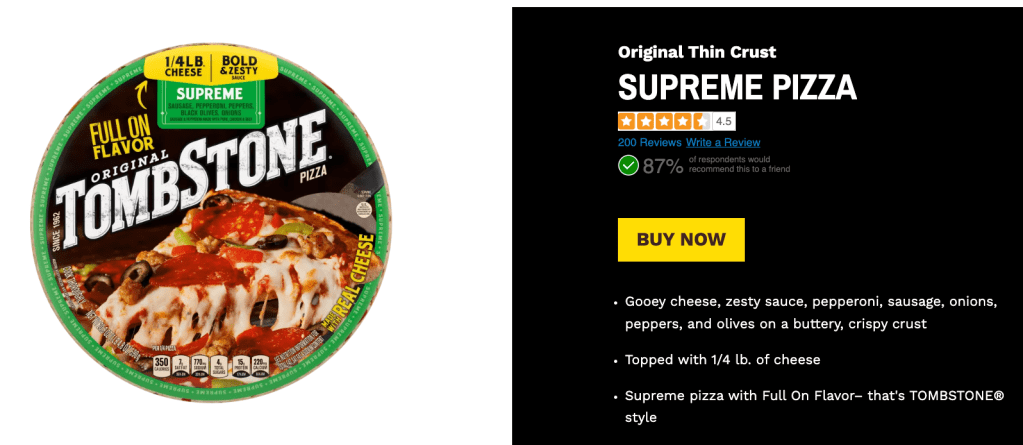
The capitalization is from the original, as is the statement regarding the bioengineered food ingredient (whatever the heck that one is). Van Kellehen explains the industrial functions of many of the above ingredients in this pizza-like product; you will have to purchase a copy of the book to find out for yourself what they are. The corporate website that I got the Tombstone ingredient list from is “Goodnes.com” so I am taking that to mean that Tombstone pizzas are packed with “goodnes.”
Tombstone, the brand, was started in a Wisconsin bar by a guy who decided that pizza would add to the bar’s menu. His recipe was a local hit, so in 1994 he sold the brand to the Nestle Corporation, who now manufactures an ultra-processed pizza using Tombstone’s name. We don’t know how similar the frozen supermarket version is to the original bar pizza.
Nestle is a Swiss mega-company that sells food in 188 countries – which is pretty much all of them – with approximately $102 billion in annual revenue. Out of 192 countries with listed GDP on Wikipedia, Nestle would rank at about 100, meaning that they are bigger than about half the world’s countries. Nestle gets a lot of air time in this book. And not in a good way; there is an entire chapter on how Nestle is replacing traditional food in the Amazon with manufactured and ultra-processed food resulting in an obesity, disease, and hunger epidemic for the local population.
In summary: the problem is not the nutrients, it’s the processing.
Here is the definition of UPFs by the pioneering Brazilian researcher Carlos Monteiro: ‘formulations of mostly cheap industrial sources of dietary energy and nutrients, plus additives, using a series of processes and containing minimal whole foods’.
Highly processed food is prepared that way for a reason: it is less expensive to manufacture per calorie, it is engineered to taste delicious, it doesn’t fill you up so you purchase more, it has a branding identification that makes it appealing in the store and generates purchaser loyalty, and it has a long shelf life. All of these things make it very profitable to the manufacturer. None of them has much to do with what your body has evolved to need in order to stay healthy.
This book appealed to me because 1) I would like to continue losing weight, and have hit a plateau; 2) I love a good counter-narrative story; 3) I am quite willing to believe that large corporations do bad things because of their design and structure despite the good intentions of their executives and employees. So I have started an experiment of eating little to none of these so-called UPFs. Ask me in a month how it’s going.
The author, Chris van Tulleken, mentions Michael Pollan as an early inspiration. His mantra, “Eat food. Not too much. Mostly Plants” has significant overlap with “Ultra Processed People.” Pollan describes what you should eat to stay healthy and to provide your body with the food it is designed to use. Tulleken, on the other hand, describes how large corporations have captured our food supply, and consequently what you should not eat in order to avoid industrial food-like products. It’s a different approach, and scarier.
I report, you decide.
 Grandpa Dave Reads the News